


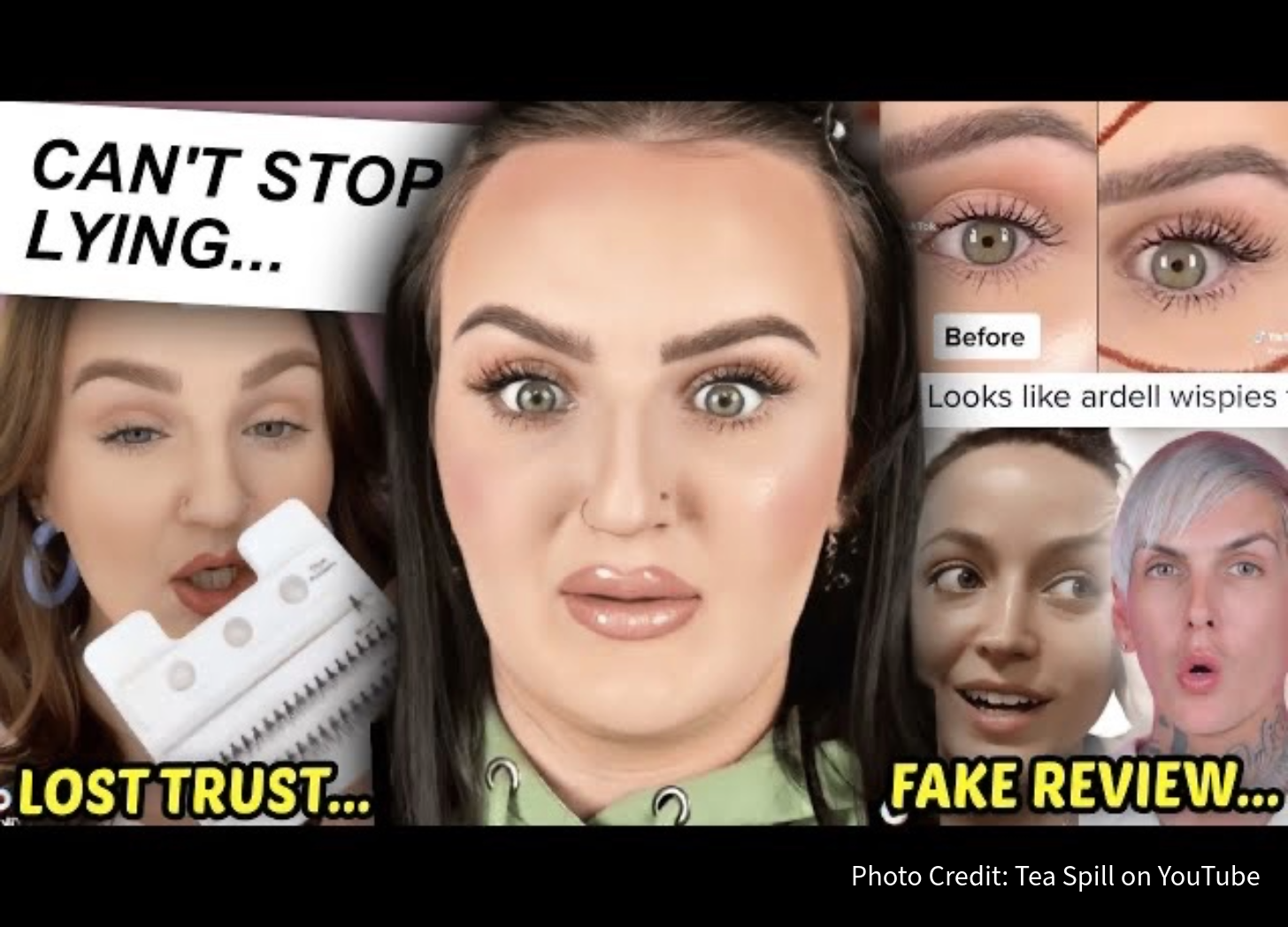
The vindication arrived without fanfare, just data, quietly confirming what I’ve been predicting for years:
Consumers now realize how much they’ve been manipulated and deceived by top beauty influencers. They’re finally understanding that an influencer is PAID to promote products, reciting carefully worded scripts from a brand’s marketing sheet full of half-truths and pseudo-science. It’s their JOB to INFLUENCE YOU TO BUY what they’re reviewing - that’s why they’re called INFLUENCERS.
Back when I was young, and dinosaurs roamed freely, we called them SALESPEOPLE.
I get it, it’s embarrassing to admit that the top beauty influencers you’ve built a parasocial relationship with are not the trusted “friends” you thought they were. That even though they claim to “love you,” in reality, they view your relationship as purely transactional. You have every right to be pissed off that your good faith has been taken advantage of.
These revelations have caused a considerable shift in consumer trust, and we find ourselves returning to the EXPERT ERA on social media platforms. Consumers are now actively seeking the point of view of industry experts with the credentials and years of experience to validate their reviews and ingredient data.
If you’re imagining me smiling smugly as I write this, you’d be correct. 😉
Oh, and I’ll try not to say “I told you so” too loudly.
The Numbers Don’t Lie
McKinsey’s State of Beauty report puts it in plain numbers: only 7% of consumers across the EU, the US, and Asia are discovering brands via influencers - that’s down from 15% in 2023. In just over two years, influencer-driven brand discovery has been CUT IN HALF. And when consumers were asked where they go for trusted beauty information, only 18% pointed to influencers.
The report cites that consumers are seeking information and honest reviews from expert voices in the industry: cosmetic chemists and product developers, dermatologists, estheticians, hair stylists, and makeup artists. The report does not cite beauty influencers. The report does not cite celebrity brand founders with large social media followings. The report cites EXPERTS. The people who have spent their entire careers developing real, demonstrable knowledge.
I’ve observed the shift in trust beginning as we emerged from the COVID pandemic, then accelerating rapidly after the Mikayla Nogueira L’Oréal #LashGate incident in January 2023. But even then, industry insiders kept giving me side-eye when I’d warn them that a shift was underway and the influencer bubble was about to pop. Well, now there are multiple published reports, with real numbers, that confirm what I’ve been saying.
And yes, I’m smiling smugly again.
The Trust Shift Driven by Dupe Culture
A key driver in the trust shift has been “dupe culture”. Dupe culture grew out of consumer frustration with beauty influencers pushing high-priced products (products they were paid to promote).
Suddenly, dupes of the most viral cosmetics were popping up everywhere - at a fraction of the price! But here’s the thing - dupe brands weren’t a knight in shining armor, magnanimously addressing the consumer demand for better-priced products; they were running the exact same playbook. They paid influencers to deliver carefully scripted talking points like “This is JUST AS GOOD as the $75.00 version by blah-blah-blah.” “Honestly, I like it BETTER.” These sales pitches were written by marketing teams whose objective was to convince consumers that prestige and luxury products are a scam. And they enlisted top beauty influencers as the key drivers in a coordinated campaign to demolish confidence in premium-priced formulations… and it worked.
Thanks to deceptive, often misleading dupe marketing, we now have an entire generation of cosmetic consumers who have been brainwashed (by paid beauty influencers) to feel ripped off by prestige or luxury brands. And to believe that a dupe, which costs a fraction of the price, is a credible, almost exact replacement. These influencers were not just misleading their followers; they were paid to LIE.
STORY TIME:
Remember when Jaclyn Hill swore undying devotion to her “Summer, can’t live without staple…Chanel Bronzer”? She agreed it was overpriced, but swore it was a worthwhile investment and that this was the fourth Summer she was using it.
Her followers willingly shelled out the $$$ for the Chanel Bronzer… until Jaclyn started pushing a Morphe bronzer as a dupe for the pricey one she couldn’t live without.
Back then, her followers didn’t realize she was paid by Morphe to make the switch, OR that she was throwing the Morphe bronzer back in the drawer and reaching for the Chanel bronzer the moment the camera was off.
That wasn’t a product review. It was an infomercial, a carefully calculated PAID performance. And it became standard practice among top beauty influencers across all cosmetic categories (skincare, haircare, makeup, etc.).
Numbers back this up. According to the Better Business Bureau’s (BBB) 2025 Influencer Trust Index, a survey of more than 3,700 U.S. consumers found that 70% felt negatively toward an influencer when they discovered that brand sponsorship wasn’t disclosed. 37% said they felt outright deceived. The industry’s response was to require influencers to add the hashtags #ad or #sponsored somewhere in the video or description box. Interestingly, the same report found that 57% of consumers said those disclosure hashtags did not build trust whatsoever. Which proves you can’t solve a credibility crisis with a hashtag.
Pros Get Caught In The Crossfire
The damage didn’t stop with manipulating consumers. It followed beauty professionals into the (makeup) room and caused quite a bit of tension.
Working makeup artists outfit their kits with professional-grade products and tools that meet the performance and durability demands of their job across all media formats (photo, film, video). But clients who had spent months absorbing paid influencer content started showing up with opinions about the products we used. Why was your kit full of brands they never saw on socials? Why weren’t you using the products that their favorite beauty influencer called a “holy grail”? Back then, they didn’t realize their favorite influencers were paid for a glowing review. They trusted their opinion, like a good friend, so if the products they praised weren’t in your kit, you couldn’t be very good at your job. 🤬🤬🤬
RECAP: Consumers are walking away from the influencer-driven marketing model because they realize most top influencers are paid to sell, not inform. Their trust was broken for a paycheck.
Online Product Reviews
McKinsey’s data also shows where else a shift is happening: online product reviews on retail websites. Consumers no longer believe the “compensated” reviews by people who receive products gratis (free) because they’re on a PR list. “Verified Buyer” reviews have become the trusted source of beauty discovery for 51% of consumers surveyed. Consumers want to hear from people who PAID for the product, have used it consistently, and offer uncompensated, real-world experience in their review.
Experts Have Always Been The Best Resource - And Consumers Finally Got the Memo.
Which voices have been providing accurate, citable information through all of this? Experts with no brand compensation attached to our point of view. Which is exactly why consumers are returning to us.
Social media began with experts as its most trusted voices. Then, affiliate codes, sponsorship money, and brand deals arrived - this was the birth of the beauty influencer, where follower counts and conversion rates were favored over credentials. Scripted talking points replaced expert knowledge.
But top influencers got greedy fast, and every week they pushed another “must-have” product, which replaced the Holy Grail they insisted you had to own last week. Then, dupe culture started to gain traction, and consumers began to realize they were being sold to from both directions at once: first, they were convinced by influencers that prestige products were worth the high price tag; then, the exact same influencers were telling them those prestige products were a scam, and dupes were the way to go.
When consumers realized how they were being manipulated, the only rational response was to revolt and stop trusting reviews from beauty influencers. And when they went looking for honest advice without a sales pitch, they found themselves back where social media reviews started: with the experts. But this time, they chose us deliberately. This is not a pendulum arbitrarily swinging back to experts; it is a full-circle moment in which consumers are returning to the people who always had their best interests in mind.
They are choosing the voices of industry professionals who have watched their credentials downplayed and their expertise disregarded in favor of beauty influencers with a million followers and a brand deal. Consumers are returning to critical thinking before purchasing. They want to know how a product will enrich their lives. They want to understand how it’s made and why it works. And they want to hear it from actual experts, not influencers paid to parrot a brand’s talking points.
Many of us have spent decades building a knowledge base that cannot be faked. We know how formulas behave across skin types and in different climates, understand ingredient interactions, and know how products perform under real professional conditions: video and film production, photography (commercial & editorial), red-carpet and special events (bridal). We evaluate a product’s ability to do the job it was intended to do. PERIOD.
Brands that continue to build their marketing strategies on the influencer-driven sales model are about to experience a rude awakening.
The brands winning right now are genuinely transparent about their product development and formulation process, sourcing decisions, and pricing structures. They’re not afraid to reference their failures alongside their wins. And they actively seek validation from experts, because the credibility economy runs on exactly one thing: the truth.
#MyTwoCents
I have been in this industry long enough to remember when “influencer” wasn’t a job title. I watched brands pull budgets from consumer product education and abruptly end relationships with industry experts, redirecting their marketing dollars toward people with ring lights and large follower counts. I watched the input of industry experts systematically devalued in favor of a marketing model built on paid opinions disguised as heartfelt recommendations from trusted “friends”.
For years, I sounded like a broken record, stating clearly and repeatedly: This is not sustainable. Consumers are smarter than this. A correction is inevitable. I was told I was being naive. That expertise didn’t sell. That the era of the credentialed professional as a trusted voice was over, and I needed to make peace with it.
I would like to pause a moment to bask in being unapologetically right.
And yes, I’m smiling smugly AGAIN.😉
If you are a working beauty professional, a chemist or product developer, an educator, or anyone who has spent years building a genuine knowledge base in this industry - THIS IS YOUR MOMENT. Not to reinvent yourself into a content creator and chase an algorithm. But to show up as exactly what you already are: the credentialed, experienced voice that consumers are now actively looking to so they can make informed purchasing decisions.
Consumers are walking away from carefully lit, highly filtered talking heads regurgitating a brand’s advertising points straight from a marketing sheet. They want to hear from experts who can read a product’s ingredient list and explain whether it aligns with the brand’s marketing claims. They want to hear from experts who have actually stress-tested a product’s performance under real working conditions. They want transparency, not a sales pitch fueled by an undisclosed sponsorship.
The cosmetic industry is finally catching up to what we’ve known all along - trust the experts.
What do you think? Have you noticed the shift? Let’s discuss in the comments.
Kevin James Bennett is the publisher of In My Kit®. He is an Emmy Award-winning makeup artist, cosmetic developer, educator, and consumer advocate. Learn more at www.kjbennett.com
Hallelujah! Sing it from the raftors. Love this information, have agreed with you the entire time and am so glad to see these changes.
This resonates so deeply with me. As a 60 year old woman who grew up surrounded by beauty industry and former makeup artist, I feel that the “influencers” who are losing the most credibility are those marketing to my demographic. “Mature skin” “anti-aging” “best luxury products” etc. why is there an assumption that I am more gullible at my age, and/or have money to burn? I buy what works, what ingredients I trust and only read verified reviews. Worst line I hear from mature influencers js “if you know me you know I am picky about what I put on my face, neck, hair, etc” then they promote the same product 5 other “mature influencers” are on YouTube promoting. It’s all such BS. Thanks for keeping it real!!!