


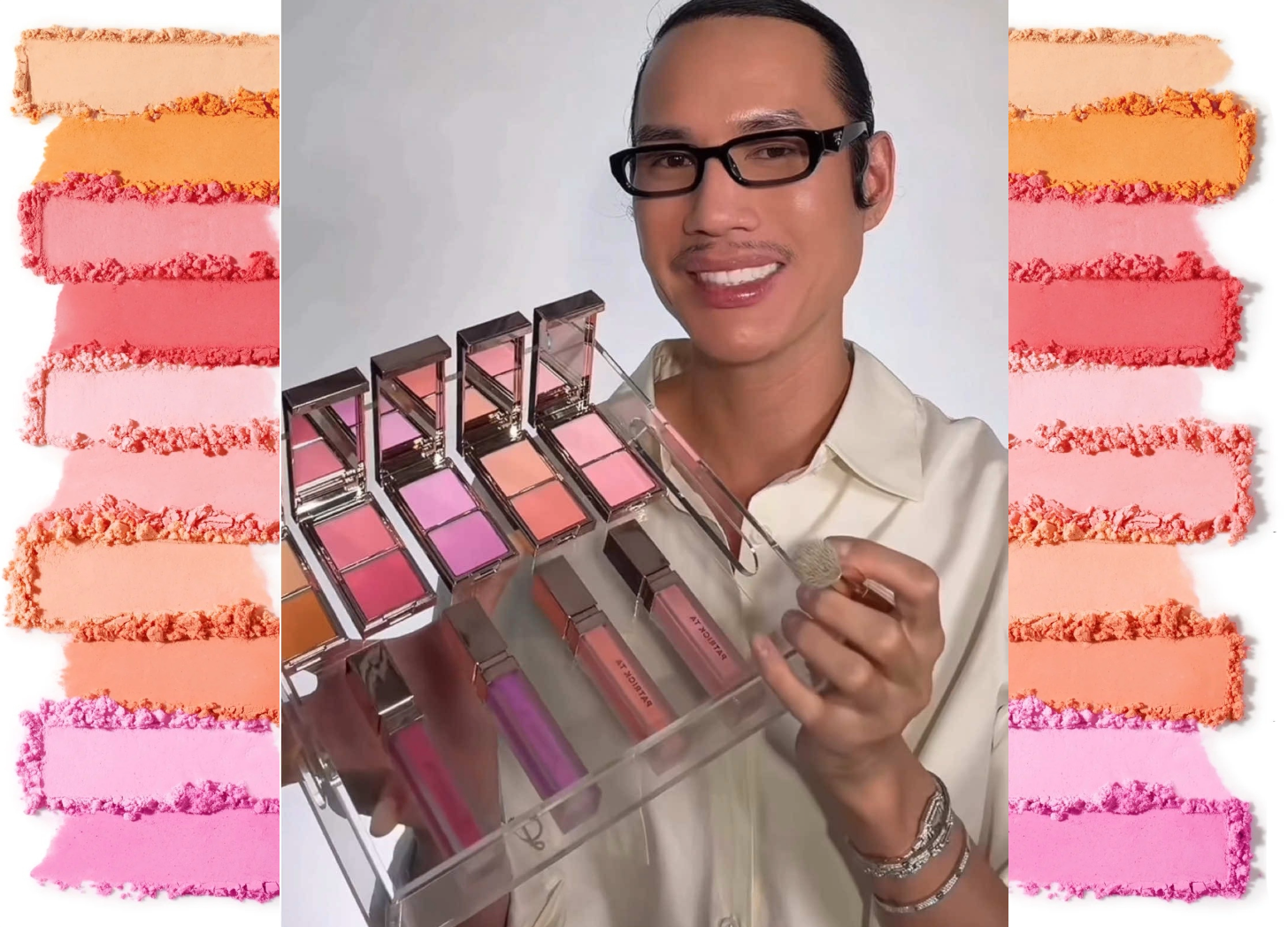
The Patrick (Ta) Problem is bigger than blush, it’s bigger than withholding payments from assistants and other creators, it’s bigger than undercutting peers, and devaluing an entire profession. We’ve watched Patrick Ta’s behavior evolve into a pattern over a decade, and at this point, that pattern no longer looks like a series of rookie missteps or misunderstandings; it looks like a lack of ethics and a broken moral compass.
Well, the 💩 (or should I say blush?) has finally hit the fan, and people are over Patrick’s attitude, problematic past, and are finally saying - ENOUGH!
But to better understand how we reached the boiling point, we need to go back to the beginning.
The Pattern Begins: Working for Free
Long before Patrick Ta launched a beauty brand, he was making a name for himself in the unethical way too many social-media-era makeup artists do — by doing celebrity makeup for free in exchange for permission to post about it on social platforms. That was how he climbed the social media celebrity ladder quickly and became “Insta-Famous”. It was a time when follower counts were becoming a powerful negotiating tool, and Ta wanted the clout and leverage that came with them.
It worked - it also enraged working makeup artists who had spent decades building their professional reputations and establishing their rates. These artists were not “jealous” of his fame; these were busy, working professionals who understood that the moment you start handing out your skills for free, you devalue the entire profession.
Pati Dubroff, a top celebrity makeup artist with an extensive list of accomplishments, didn’t stay quiet about it. She went on record: “I’m appalled when I hear about it because it’s people like Patrick Ta that are sabotaging the entire industry by doing that. Lucky for him that he can afford to do that, but the rest of us have to work for a living.” That quote landed in 2017. Many of us joined Pati in denouncing the practice. Ta kept doing it anyway.
Working for free in exchange for exposure is the oldest hustle in our profession, and it is always the self-absorbed attention seekers (narcissists?) that don’t care how it impacts others, as long as it serves them. When you work for free, you don’t just devalue yourself — you’re making a statement that a professional makeup artist’s rates can’t be taken seriously, because their skills can be found for free. You make it harder for every artist to negotiate a fair rate and make a living.
The industry noticed the drama - and then, because the industry has a relentless appetite for the next thing, and a short memory, it moved on.
Rinse, Repeat: The Pattern Continues with Black Creators
Fast forward to December 2024. TikTok creator and beauty influencer Avonna Sunshine, who has nearly 500K followers, posted a video calling out brands for failing to compensate Black content creators. She never called out Patrick Ta by name. She didn’t have to - she spent the entire video destroying Patrick Ta Beauty products over a garbage pail.
The video has over 11.2 million views.
Sunshine had sent emails. She DM’d Ta directly. She had, as she put it, “gone the nice way.” She wasn’t angry when she first reached out. She was a professional asking to be compensated for her work. But after being ghosted, she did get angry, recorded the video, and it went viral.
Ta’s response? A tearful TikTok apology. Except here’s the thing — he posted one apology video, then deleted it and replaced it with a duplicate, but in this one, he was crying. Ta claimed the crying take was “the most authentic” one. Influencer Tiffani Davis called it out immediately. “He knows he f—ed up,” she said, noting the manipulative fake tears in the second apology video.
“I want to get you compensated as soon as possible, today if you are willing to answer me,” Ta said in the video, adding that his finance team was responsible for the oversight.
His finance team. Right. 🤨
This was not an isolated incident for his “finance team”. Around the same time, Jools LeBron — the creator behind the viral “very demure, very mindful” phrase — also came forward claiming Ta had failed to pay her for a campaign they’d done together in New York. Two Black creators not being compensated? The receipts weren’t just piling up. They were exposing a pattern.
The Transition Blush Takeover
Which brings us to May 2026 and the move that finally broke the internet’s patience with Patrick Ta’s shenanigans.
Patrick Ta Beauty launched its Transition Blush Collection — the Liquid Transition Brightening Blush, the Transition Blurring Blush Duo, and a matching double-ended brush. The internet recognized the “transition blush” aesthetic immediately because it had been a signature technique of makeup artist Painted by Esther (Ngozi “Esther” Edeme) for years.
Esther is a UK-based celebrity makeup artist whose client list includes Naomi Campbell, Kelly Rowland, and Viola Davis. She built her professional reputation and following around a bold, high-set blush technique — layered blush gradients that sweep above the cheekbones and into the temples, specifically designed to create a seamless, elevated blush look on deeper skin tones. It was called “transition blush,” and the internet recognized it as a technique Esther popularized - not Ta - even though he has repeatedly called it a technique HE created - but more on the technique’s origins later.
Ta’s response, via TikTok, was a masterclass in non-apology apologizing. He tagged Esther, acknowledged that she “popularized this look through her artistry,” and then immediately qualified his own position, claiming he’d been doing a version of this blush since 2021. He went on to say he’d been developing these products for a year and a half, that his interpretation was different, and that he’d even reached out offering a paid collaboration before launch. Basically, he wanted Esther to “collaborate” as a seal of approval so he couldn’t be accused of stealing and profiting from her technique. Esther’s team declined that offer — a fact he made sure to state, to demonstrate his due diligence. The internet didn’t buy it.
What makes this even harder to dismiss is that Ta had already tipped his hand in earlier videos. When followers noticed his work shifting away from the cream-over-powder technique he’d become known for (not without its own questions of origin), they asked him about it directly on social media. His reply was candid to the point of self-incrimination: he was leaning into Painted by Esther’s techniques. Which means he was very aware of her work and liked it enough to emulate it. He made that comment, in writing, voluntarily. The receipts, in this case, were his own.
Then came the detail that turned “suspicious” into “damning.”
Creators began playing back one of Ta’s tutorials, side by side with Esther’s content, and the language wasn’t just similar — it tracked almost verbatim. The structure, the phrasing, the cadence, the application techniques. People who knew Esther’s work recognized it immediately. But the moment that sealed it was four words: “back of my palm.”
If you’ve followed Esther’s tutorials, you’ve heard that phrase. That specific type of mistake is called a malapropism or a lexical error, because an incorrect word was substituted to convey a thought. The correct expression is “back of my hand.” Esther has acknowledged it was an accidental verbal fumble in one of her own videos, the kind of slip unique to a specific piece of content. When Ta used that exact phrase in his tutorial — her mistake, her switched words — TikTok collectively stopped scrolling. You don’t accidentally repeat a mistake like that. You repeat it because you were reading from a transcript of Esther’s video while recording yours.
But here’s where the story takes a turn from messy to chillingly calculated.
Patrick Ta Beauty filed a trademark claim for the phrase TRANSITION BLUSH with the USPTO on May 7, 2025 — a full year before the product launched. It’s been suspended due to a conflict, but it is still a live trademark request. No one outside his team would have known about this. Ta’s public narrative was “I reached out to collaborate, Esther declined, so I launched my own version.” What he didn’t disclose was that a year ago, he began legal action to seize ownership of the term most closely associated with Esther’s work. Patrick knew his trademark move was shady AF, but he didn’t care because it benefited him. If the trademark goes through, and Esther ever wants to launch a product under the name she popularized, she would now face legal obstacles created by Patrick Ta.
This is a deplorable, unethical strategy we’ve watched play out before, and don’t dare call it “the price of doing business” - it’s a dirty way to legally STEAL from other creatives. This is no different than Jaclyn Hill stealing “KOZE” from fellow content creator Kalyn Nicholson and forcing her to close an established business and social media channel. This is no different than Hailey Bieber stealing “Rhode” from a successful $14.5 million clothing brand that lost the trademark battle and was forced to close.
Patrick Ta knew what he was doing and didn’t care about how it would impact Esther’s career and future opportunities. It was cold, calculated, and right in line with the pattern of behavior he’s established over the years.
The Contrast That Says Everything
What makes this particularly heartbreaking is how Esther handled it.
She didn’t explode. She didn’t go scorched earth. In her response video, she said what any artist with real integrity says: “I did not start anything. I am 29 years old. That would be ludicrous to claim ownership of anything. But what you will not belittle is my influence.”
She credited the artists who shaped her — Kevyn Aucoin, Sam Fine, Danessa Myricks, Pat McGrath. She spoke about wanting to move the way they do: with grace and intentionality. She positioned herself as a link in a long chain of creative tradition, not its originator, while making it clear that her contribution was real, specific, and should not be dismissed.
The Kevyn Aucoin estate weighed in, and while their statement was measured, who they chose to validate and who they chose to ignore spoke volumes. They confirmed that Aucoin was an originator of the technique (which he learned from his mentor, Way Bandy) and named Painted by Esther as one of the artists who had refined it and brought it to contemporary mainstream audiences. Patrick Ta’s name was notably left out of the conversation. The Aucoin estate didn’t drag him. They just didn’t include him. And in a conversation about artistic legacy, being purposely omitted speaks volumes.
And then, almost as a side thought, they pointed to their own Neo-Blush, a gradient blush product the brand introduced nearly a decade ago, which is VERY similar in function to what Ta is now calling his “Transition Blush.” A product that predates this entire conversation by almost 10 years. The message from Aucoin’s estate was polite. The implication of imitation, not innovation by Ta, was not.
👏👏👏 (slow clap for the Aucoin estate)
Esther didn’t claim ownership of this technique. She claimed to have adopted a technique from an iconic artist (Aucoin), put her own spin on it, and popularized her contemporary version through her influence. There’s an enormous difference between embracing an existing technique and claiming ownership of it, and she articulated it perfectly. Patrick Ta, in glaring contrast, filed for a trademark so he could legally steal something he DID NOT CREATE, and call it his own.
What This Is Really About
Every single incident in Ta’s history follows the same pattern. He crosses lines that impact others, either financially or artistically, gets called out, and produces an apology carefully calibrated to sound contrite while admitting no accountability. His behavior doesn’t change. The only thing that changes is who his latest insincere apology is directed at.
The trademarking of “Transition Blush” is the tell that makes the rest of the pattern impossible to dismiss as a misunderstanding. You do not accidentally file a federal trademark application for a term you know damn well is a shared technique. You do not covertly build a legal wall around another artist’s signature look and language, then turn around and say you reached out to collaborate - when the reality is, Ta attempted to secure her seal of approval for the THEFT of her artistic contribution.
This was not a misunderstanding. It’s a person who has spent a decade telling us, through his actions, that the rules of professional ethics, of creative integrity, of basic human decency — simply don’t apply to him. Ta has consistently proven himself willing to sacrifice anyone else’s career, livelihood, or creative legacy in the service of his own ambition. Every single time.
#MyTwoCents
I’ve watched this industry romanticize rabid ambition for so long that we’ve stopped calling it what it actually is: a career ascent defined by ruthlessly climbing over others, assimilating their accomplishments, calling them your own, and then attempting to erase the originator from history.
Patrick Ta is not a cautionary tale about ambition. He is a case study in what happens when there are no real consequences for repeated, documented disrespect of professional norms and creative ownership.
Pati Dubroff called Ta out in 2017. The industry took notice for a week and moved on. No consequences.
Avonna Sunshine called Ta out in 2024. Patrick cried crocodile tears on TikTok, and the industry moved on. No consequences.
Now, Painted by Esther is calling Ta out, armed with a trademark filing date and a receipts trail that stretches back nearly a decade.
Are we going to be outraged for a moment, then move on as if nothing happened, giving Ta permission to do it AGAIN? When is enough, enough? When does the cycle stop???
The strategy to end this is pretty simple: use your critical thinking skills and take the time to know who you’re supporting. How did they acquire their fame? Have they acted ethically? Do they support the rest of the community? Or do they manipulate it solely to serve themselves?
If people followed this strategy, unethical people like Jaclyn, James, Mikayla, and Patrick wouldn’t have the platforms or influence we’ve mistakenly given them.
What do you think? Let me know in the comments.
Kevin James Bennett is the publisher of In My Kit®. He is an Emmy Award-winning makeup artist, cosmetic developer, educator, and consumer advocate. Learn more at www.kjbennett.com
I teared up when I saw that the Kevyn Aucoin estate told Ester that Kevyn would have loved her.
Thank you for a clear breakdown of this issue. I am now enlightened and will no longer buy Patrick Ta products. This is how we collectively respond and refuse to support his business.