


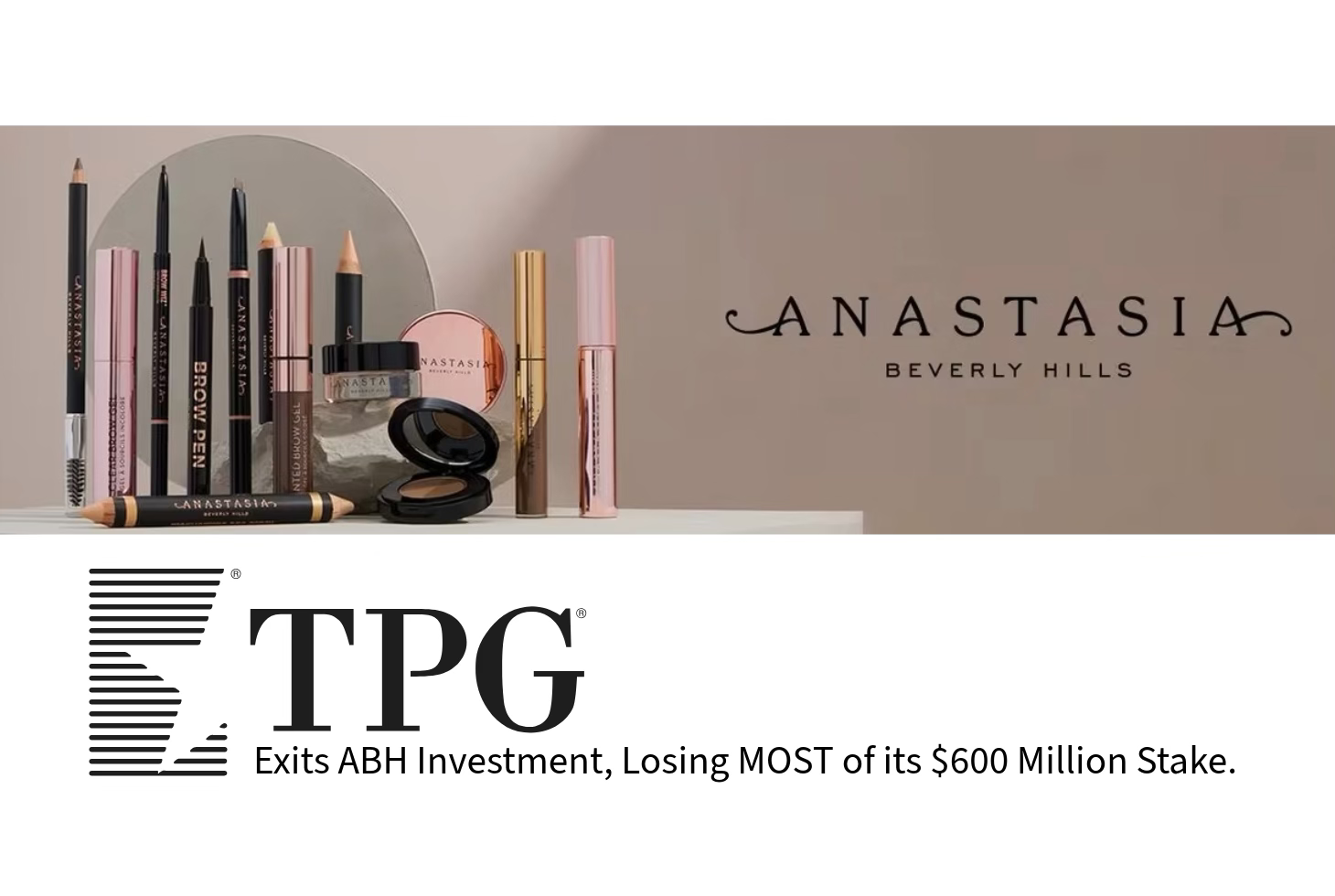
If you watch the beauty industry’s mergers-and-acquisitions space long enough, you develop a sixth sense for when a brand’s financial health is in decline. Anastasia Beverly Hills (ABH) has been on life support for years, and TPG has been watching its poor investment linger, so they finally decided to pull the plug.
A $600 million plug.
There’s no nice way to frame this…
TPG just took a financial bloodbath, slashing its stake in ABH from 38% to roughly 6% through a debt restructuring that effectively vaporized its $600 million investment from 2018. And before anyone tries to spin this as some “brilliant strategic repositioning,” let’s call it what it is: a near-total wipeout.
The Peak: When Everyone Wanted a Piece
Let’s go back to 2018. ABH was riding a reported $3 billion valuation—the kind of number that makes CFOs salivate and founders believe their own press releases. Anastasia Soare (founder of ABH) and daughter Claudia (Norvina on socials) had genuinely built something people were noticing. They turned eyebrows from an afterthought into a mainstream art form to grab market share, then rolled out a fully realized range and rode the social media marketing wave like a pro.
TPG saw that ABH was an Instagram darling with explosive growth metrics and double-digit EBITDA margins (Earnings Before Interest, Taxes, Depreciation, and Amortization). On paper? TPG saw buying equity in ABH as a no-brainer for a quick return on its $600 million investment.
In reality? They were buying at the absolute top of the brand’s clout, and there was nowhere to go but DOWN.
The Cracks Begin To Show
Here’s where the industry insiders started getting nervous. By Q3 2023, net sales had crashed 12% year-over-year to $69.8 million, while adjusted EBITDA had imploded by 33.5%. That’s not a correction—that’s a brand in free fall.
The credit agencies saw it coming from a mile away. Fitch downgraded ABH to junk status in 2020, projecting that revenue could nosedive by around 30% that year. More telling? They estimated EBITDA peaked at $175 million in 2017 and was now bottoming out at around $40 million—a 77% collapse that would make any private equity firm break out in hives.
Death by a Thousand (Norvina) Product Launches
The official excuse for a dying brand is always “shifting consumer preferences” and “challenging macro environment.” Translation: they got outmaneuvered.
Consumer demand (and trust) shifted away from ABH when its carefully crafted identity as a high-quality prestige brand was muddied and cheapened by a persistent string of low-grade, fast-makeup products (Ali Express) that were pushed by Soare’s daughter, Claudia (Norvina), to grab sales from less expensive brands like Morphe, Colour Pop, and Juvia’s Place.
This did not sit well with the loyal ABH fans. They didn’t want drugstore makeup with an ABH logo (looking at you, again, Norvina 🤨); they wanted the PRESTIGE-level formulas ABH used to offer. And competitors stopped flooding the market with cheaper alternatives to ABH’s products - because ABH had already downgraded their quality and pricing.
But here’s the really damning metric: ABH’s Instagram following was approximately 17 million in 2018, and has only grown by 1.3 million in 8 years (18.3 million IG followers as I write this). For a brand that was supposedly built on social media marketing dominance, that’s not growth—that’s stagnation masquerading as stability.
The Debt Spiral Nobody Talks About Publicly
This is where it gets uncomfortable. The company operated under forbearance after missing a loan payment, triggering a cascade of credit downgrades. With over $600 million in loans maturing, ABH wasn’t just facing a liquidity crunch—they were staring down a potential restructuring nightmare.
Founder Anastasia Soare is reportedly considering injecting around $225 million to keep things afloat. Which raises the obvious question: if the business fundamentals are so “resilient” (an ABH spokesperson’s word, not mine), why does it need a nine-figure emergency capital infusion?
The Broader Carnage
ABH isn’t an isolated incident—it’s emblematic of an entire era of overzealous beauty deals going south. TPG’s other questionable beauty play from that period, Rodan + Fields, defaulted on its debt in July, while the competitor Norvina tried to emulate, Morphe, filed for bankruptcy in March 2023.
Those 2017-2018 valuations were built on Instagram growth rates that assumed compound annual growth would continue indefinitely. Spoiler: it didn’t. The social media algorithm changed, TikTok fragmented marketing attention, and suddenly those 9-12x revenue multiples looked less like shrewd investments and more like auction fever.
#MyTwoCents
TPG put in $600 million. They’re walking away with roughly 6% equity in a distressed asset. Even if you’re generous with the math, that’s a loss that’ll show up in fund performance reports for years.
Anastasia Soare built something genuinely impressive, but even the strongest brands can’t sustain the weight of overleveraged capital, especially when market conditions shift. Peak valuation earned that name for a reason - it marks the PEAK value of a brand…and we all know what happens when you reach a peak, there’s nowhere to go but DOWN.
The brand still has Sephora placement, Ulta distribution, and name recognition. But with mounting debt, declining sales, operational challenges (looking at you, again, Norvina), and a market that’s moved on from their confusing aesthetic? The turnaround playbook here requires either a miracle or a fire sale.
I’m betting on the fire sale.
Such an amazing read! I also feel like their responses on social media to criticisms or feedback on products have been reading like a major clapback. Not a good look for a business owner
Thank you. Now tell me what’s going on with Pat McGrath. 🥴