

This Is Not Wellness Education. This Is Misinformation.
When a trade publication repeats consumer fear-mongering as fact, the professionals who trust it pay the price.

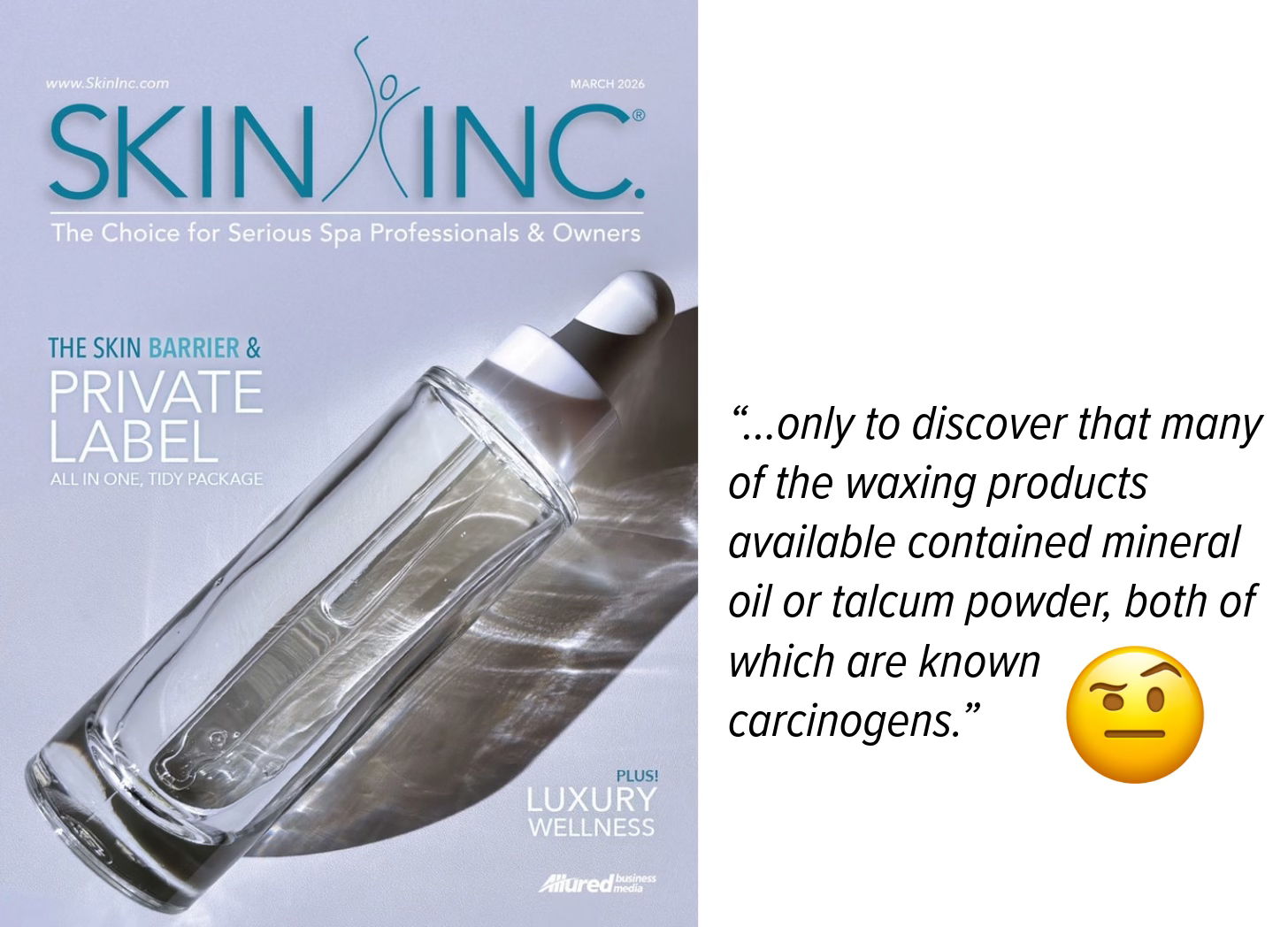
There’s a sentence sitting inside a recent Skin Inc. article discussing a brand founder’s “Considerations in Private Label” that should not have survived an editorial review. It was written by the publication’s managing editor, Kitty Lin, and it reads:
“...only to discover that many of the waxing products available contained mineral oil or talcum powder, both of which are known carcinogens.”
That claim is factually incorrect. Not edgy. Not provocative. Not a matter of ongoing scientific debate. Incorrect.
And the reason I’m alarmed - genuinely alarmed - is that Skin Inc. isn’t a wellness influencer’s Instagram page or a TikTok account. It’s a professional trade magazine. The estheticians and spa directors who read Skin Inc. trust it to provide accurate information they can carry into their treatment rooms and share with their clients. That trust has been violated. And printing this article without correction is a failure of professional journalism.
Right now, somewhere, a spa owner or esthetician who trusted this trade publication to fact-check properly could be passing misinformation to their clients. Or they’re quietly second-guessing all the products they’ve used safely for years.
That is the real-world cost of getting information wrong in print.
So let’s dive into it.
First of all, I’d like to clarify that I did not discover this article or its misinformation randomly. This article was featured in the Skin Inc. March newsletter. (see image below)
Think about it, Skin Inc., a trusted information resource to the spa industry, directed its subscribers to this article, which means they knowingly promoted misinformation. That’s NOT OK. 🤬

Mineral Oil Is Not a Known Carcinogen. Full Stop.
Cosmetic-grade white mineral oil — listed on ingredient labels as Mineral Oil, and regulated under USP and NF monographs — is classified by the FDA as Generally Recognized as Safe (GRAS) for direct food applications under 21 CFR 172.878, and is fully approved for cosmetic and pharmaceutical use. It is used in food, drugs, and cosmetics across the U.S., EU, Canada, Japan, and virtually every other major regulatory market on earth. It is an ingredient in pharmaceutical-grade skin protectants, laxatives, and pediatric formulations.
There is an IARC classification that applies to certain mineral oils — but context is everything. IARC Group 1 ("known human carcinogen”) applies to untreated and mildly treated mineral oils used in industrial metalworking fluids and occupational settings, where workers experience chronic, direct skin exposure to impure, unrefined product. That classification is based on evidence of scrotal and skin cancers in industrial workers — not cosmetic users, not waxing clients, not anyone in a treatment room.
Cosmetic-grade white mineral oil is a different material. The refining process that produces it - removing polycyclic aromatic hydrocarbons and other impurities to meet pharmacopoeia purity standards - creates a substance that no regulatory authority classifies as a carcinogen for cosmetic use. Not the FDA. Not the EU’s Scientific Committee on Consumer Safety. Not IARC. Not Health Canada.
Conflating industrial mineral oil with cosmetic-grade white mineral oil because they share a name is the kind of error you’d expect from a random wellness blog optimized for clicks. It is not what you expect, or should accept, from the leading trade publication for professional estheticians.
The Talc Conversation Is Complicated. That’s Exactly Why Precision Matters.
Talc deserves more careful handling precisely because the science is genuinely evolving — and sloppy language obscures the real story rather than telling it.
In July 2024, the International Agency for Research on Cancer reclassified talc (not containing asbestos) from Group 2B — “possibly carcinogenic” — to Group 2A — “probably carcinogenic to humans.”
That is a meaningful development. It reflects limited human evidence for ovarian cancer risk and sufficient animal study data, and it is driving real regulatory action: the EU’s Committee for Risk Assessment classified talc as a Category 1B carcinogen in September 2024, separate from the asbestos contamination question, and the EU is moving toward a 2027 ban on talc in cosmetics. These are consequential developments that professionals absolutely need to know about.
But here is what IARC Group 2A means: probably carcinogenic, with limited human evidence. It is the same classification as that of red meat, aloe vera extract, and the herbicide glyphosate.
It is not a Group 1 “known carcinogen”, which requires strong, consistent, replicated human evidence.
That distinction is not a technicality — it is the difference between a serious precautionary concern and a settled verdict. Remember, the same “probably” classification applies to red meat.
I’m not trying to be dramatic, but Skin Inc. calling these ingredients “known carcinogens” is no different than the Nation's Restaurant News (NRN), known for comprehensive coverage of the food industry, calling red meat a “known carcinogen”. Words mean things, especially in professional education.
When you replace a nuanced, important story with an inaccurate label, you don’t protect people — you frighten them. And frightened, ill-informed clients are harder to help, not easier.
Furthermore, the FDA has not banned talc in cosmetics. It proposed a rule in December 2024 that would require standardized asbestos testing for talc-containing cosmetics. This rule was subsequently withdrawn under political pressure by that idiot RFK Jr. in November 2025, not due to scientific reassessment. The FDA’s own 2024 testing of 50 talc-containing cosmetic samples found no asbestos. The agency has stated it will issue a new proposed rule, though no timeline has been announced.
A trade publication covering this space has a genuine, important story to tell about talc - the EU’s trajectory, about supply chain contamination risk, about what brand reformulation timelines should look like. Telling these stories requires precision. Dropping a bomb like “known carcinogen” doesn’t inform professionals. It adds more noise to an industry already drowning in unfounded ingredient hysteria.
This Is What Happens When Fear Culture Infiltrates the Trade
Special interest groups and lobbyists like EWG have built enormously powerful platforms on ingredient fear-mongering to promote their donors’ agendas and hurt their donors’ competitors. They found a formula that works: take a complex scientific classification, strip out every qualifier, cherry-pick phrases, add words like “toxic”, “carcinogen,“” endocrine disruptor,” and let anxiety do the rest.
Drama drives engagement. It has very little to do with helping people understand actual risk.
That vocabulary has now saturated wellness media so completely that it bleeds into professional coverage without anyone stopping to ask if the information is factual.
I don’t know whether Kitty Lin was leaning into information gleaned from the EWG misinformation ecosystem when she wrote this piece. What I know is that Skin Inc.’s editorial process should have caught this mistake before it went to print. The fact that it made it to print and then was FEATURED is a failure of the institution.
The trade press is supposed to be where professionals come to escape the noise, where the information has been fact-checked, contextualized, and held to a standard that respects the intelligence and professional responsibility of the people reading it. When it stops doing that job, the consequences aren’t abstract. They show up in treatment rooms, in client conversations, in purchasing decisions made on bad information.
The Professionals Reading This Deserved Better
I keep coming back to the estheticians. The spa directors. The waxing specialists who opened Skin Inc. read that sentence and had no reason to question it because it came from their trusted trade magazine. They are good at their jobs, care deeply about their clients, and do exactly what professionals are supposed to do - stay current, read the trades, and bring that information to work.
Unfortunately, they were handed information that wasn’t true.
That’s what upsets me most about this. Not the regulatory nuance. Not the classification terminology. The fact that real professionals were misled by a source they had every reason to trust, and real clients are now on the receiving end of that misinformation.
A clear, explicit correction from Skin Inc. is not optional. It’s owed.
#MyTwoCents
Cosmetic-grade mineral oil is not a carcinogen - not by any scientific or regulatory standard, anywhere, period. Calling it one in a professional trade publication is not an editorial choice; it’s a factual error with real consequences for the professionals who read it and pass the misinformation to their clients.
Talc deserves more serious, accurate coverage, and genuinely important information is evolving all the time. I published an article about it earlier this week.
The accurate version of the current talc story is complicated and nuanced. Labeling an ingredient as “carcinogenic” without proper citation is fear-mongering.
Our industry is already fighting a losing battle against the flood of ingredient misinformation from special-interest groups and consumer media. The trade press is supposed to be the place where we get it right. Skin Inc. got this one wrong, and the people sitting in treatment rooms right now are paying the price. That’s not okay and shouldn’t be allowed to stand without correction. PERIOD.
Kevin James Bennett is the publisher of In My Kit®. He is an Emmy Award-winning makeup artist, cosmetic developer, educator, and consumer advocate. Learn more at www.kjbennett.com