


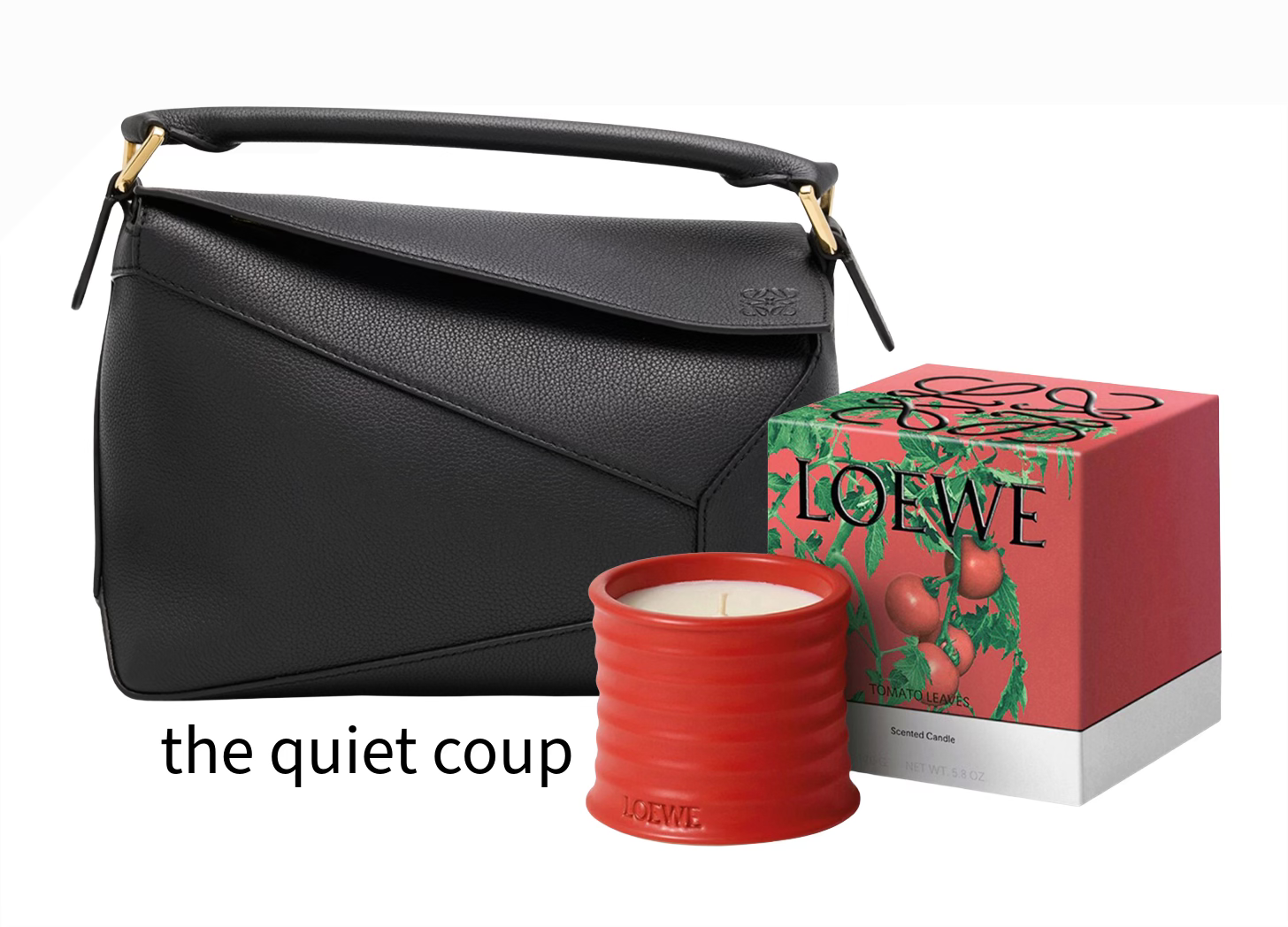
For decades, two brands in the luxury home fragrance space have become synonymous with “impeccable taste and obvious disposable income.”
You know these icons, even if you aren’t aware of the brand names - the instantly recognizable black-and-white oval label of a Diptyque candle, the amber apothecary bottles of an Aesop’s hand wash perched on a Waterworks sink. These aren’t just products—they’re cultural shorthand. Interior design currency. The olfactory equivalent of a perfectly draped Hermes cashmere throw on a Knoll Barcelona chair.
And then, while no one was paying attention, Loewe walked into the room, set down a candle in a handmade terracotta vessel that smelled like tomato leaves, and quietly started rearranging the furniture.
The Anderson Effect
To understand what’s happening, you have to understand Jonathan Anderson. Before his departure in early 2025 to take the creative reins at Dior Homme, Anderson didn’t just revitalize Loewe’s fashion business—he more than quadrupled the brand’s revenue over a decade, from roughly $250 million to nearly $950 million. He turned a heritage Spanish leather house that was gathering dust into one of the hottest luxury brands on the planet. The globally respected (and anticipated) Lyst Index ranked Loewe among the top five most desirable luxury brands in 2025.
But here’s what the fashion press overlooked while swooning over Puzzle bags and viral runway moments: Anderson was simultaneously building a lifestyle empire that operates on an entirely different philosophy than anything Diptyque or Aesop has ever presented.
When Loewe Home Scents was launched in 2020, it wasn’t just an extension of their fashion and accessory collections. It was a home collection with a point of view so specific, so profoundly rooted in craft and nature, that it made the reigning champs of the luxury home fragrance category look, well, predictable…maybe even a little uninspired.
The Terracotta Revolution
Let’s get into the details, because this is where it gets interesting. Loewe’s candles arrive in handcrafted, ribbed terracotta vessels inspired by fifth-century BC Greek drinking cups. They’re made in Spain. They’re embossed with the house’s monogram. And here’s the thing that makes a forty-year industry veteran like me sit up straight: people are buying these candles as much for the vessel as for the fragrance. Interior designers are specifying them. They’re showing up on coffee tables in Architectural Digest shoots. The empty pots are being repurposed as vases, pencil holders, tiny sculptures in their own right.
Now compare that to Diptyque, whose iconic glass vessels, charming as they are, have remained essentially unchanged since the 1960s. Or Aesop, whose amber glass and minimalist typography, once thrillingly austere and apothecary feeling, has become so ubiquitous that it’s practically a meme. (If I see one more TikTok video rating a bathroom based on whether there’s an Aesop hand wash on the sink, I may need to 🤮).
Loewe understood something fundamental: in the luxury lifestyle space, the object itself has to earn its place in someone’s environment. And it can’t just smell beautiful, it has to BE beautiful, and feel like a deliberate, curated choice.
Storytelling With Scent
Then there’s the fragrance philosophy, which is where Loewe really separates itself from the pack. While Diptyque has long traded on sophisticated French perfumery scent profiles (and done it beautifully), and Aesop has leaned into its botanical-scented apothecary identity, Loewe went somewhere nobody expected: the vegetable garden.
Tomato leaves. Cucumber. Beetroot. Coriander. Pea. Cannabis. These are not safe choices. These are not scents designed by a marketing committee looking at consumer data. These are the olfactory obsessions of a creative director who grew up with a greenhouse and had the audacity (and the LVMH backing) to say, “You know what smells incredible? A ripe tomato vine in August.” And he was right.
The Tomato Leaves candle alone has achieved something approaching cult status. Master perfumers have reviewed it glowingly. Fashion editors fight over them. And the collection has continued to expand with increasingly bold offerings—Mushroom, Roasted Hazelnut, Palo Santo, and a recent limited-edition trio of Earl Grey, Black Sesame, and Sweet Almond that sounds more like a tasting menu at a Michelin-starred restaurant than a candle collection.
This is the kind of creative confidence that builds brand mythology. And brand mythology, my friends, is the most expensive real estate in luxury.
Vulnerability of the Icons
Now, I want to be clear: I’m not writing a eulogy for Diptyque or Aesop. Both remain formidable players. Diptyque still commands an estimated 7% of the global luxury candle market and continues to perform beautifully on limited editions and seasonal collections. Their heritage is real, their craftsmanship is legitimate, and their loyal customer base runs deep.
But Diptyque has a redundancy problem. When your visual identity hasn’t meaningfully evolved in decades, you risk becoming the luxury equivalent of background music—pleasant, reliable, and increasingly invisible.
Industry analysts project that the home fragrance category will nearly double to over $1 billion by 2030 - so standing still is the same as falling behind.
Aesop’s situation is more complicated, and frankly, more concerning. Since L’Oréal acquired the brand in 2023 for a staggering $2.5 billion (the largest acquisition in the company’s history) the tension between brand integrity and corporate growth expectations has been noticeable. L’Oréal has publicly stated its ambition to make Aesop a “billionaire brand,” and while the company has maintained double-digit growth, the aggressive expansion and increasing omnipresence could erode the very exclusivity that made Aesop aspirational in the first place.
There’s also the identity question. Aesop’s strength was always its curated, almost academic approach to beauty—the brand felt discovered rather than marketed. But when you’re in 400-plus stores across 29 markets, with a parent company talking about “unleashing massive growth potential,” “discovered” doesn’t seen to apply any longer. The very TikTok virality that put Aesop’s hand wash in every aspirational bathroom is now working against it.
FACT: Overexposure is the silent killer of luxury desirability.
The LVMH Advantage
Here’s something else worth noting:
Loewe sits within the LVMH portfolio - the same conglomerate that owns Dior, Louis Vuitton, Fendi, and Bulgari. LVMH knows how to build luxury brands. More importantly, LVMH knows how to build luxury ecosystems.
Loewe’s home scents aren’t a side project. They’re a strategic extension of a brand identity that Anderson spent a decade constructing—one that marries Spanish craft heritage with intellectual, art-world credibility. The home scents collection is inseparable from the fashion shows, the Loewe Foundation Craft Prize, the collaborations with ceramic artists, and the whole carefully orchestrated world-building exercise. When you buy a Loewe candle, you’re not just buying a fragrance. You’re buying into a meticulously curated universe.
Diptyque, as beloved as it is, has not expanded its product offerings with anything innovative for decades. Aesop, nestled within L’Oréal’s Luxe division alongside Lancôme and YSL, was the acquisition of a beauty conglomerate—not a fashion-and-lifestyle ecosystem. These differences matter more than you might think when you imagine the trajectory of Loewe Home.
#MyTwoCents
The big question is: what happens to Loewe Home now that Anderson has left the brand? New creative directors Jack McCollough and Lazaro Hernandez, the founders of Proenza Schouler, are enormously talented, but they’re inheriting a brand identity deeply rooted in Anderson’s sensibility. Will they be able to continue the roll-out while remaining true to the brand DNA Anderson created?
Here’s what I think the fashion media is underestimating: the home scents infrastructure Anderson built isn’t going anywhere because:
The in-house perfumer, Núria Cruelles, remains in place.
The ceramic artisans in Spain remain in place.
The distribution through the brand’s own retail network and premium stockists, such as Net-a-Porter, remains in place.
The home scent division was established with a compelling DNA, and that DNA has proven remarkably resilient.
Meanwhile, the luxury home fragrance market continues to expand at an extraordinary pace. Consumer demand for premium, design-forward home scenting products shows no sign of slowing.
Loewe is offering something distinctively different. It’s offering terracotta and tomato leaves, along with the audacious idea that your home should smell like a treasured memory only you have. And slowly, elegantly, decisively, it’s acquiring shelf space and top-of-mind awareness reserved for the two brands everyone assumed would dominate this category forever.
Let’s be clear, Diptyque and Aesop aren’t going anywhere.
But the crown they’ve been sharing for a few decades…it’s sitting on a table next to a Loewe Puzzle Bag in a room that smells like a Spanish garden in August.