


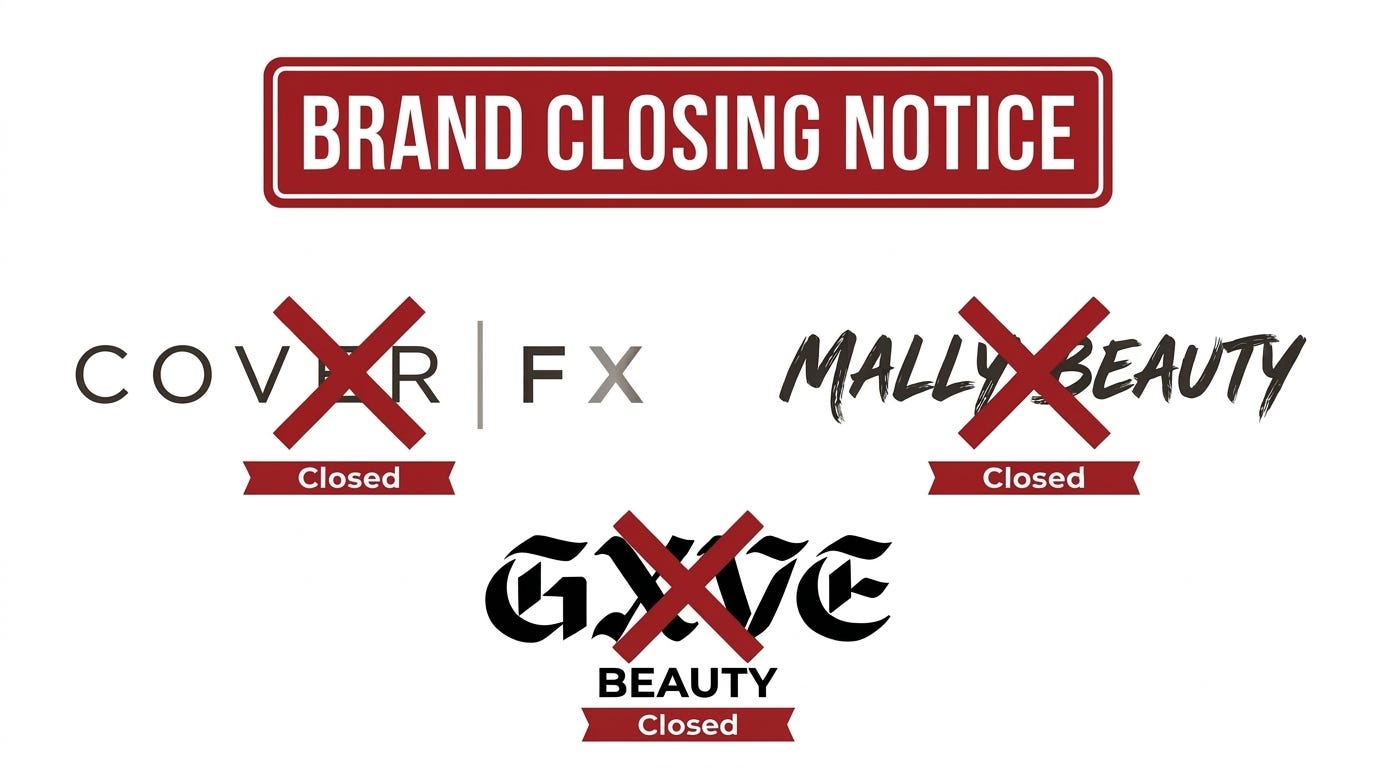
CoverFX is gone. Mally Beauty is gone. Gwen Stefani’s Gxve Beauty is gone. Malin + Goetz shuttered its UK operation. Good.clean.goop folded. Ami Colé. Youthforia. Sknmuse - the list grows daily, and we’re barely halfway through 2026.
These closings are not as alarming as you might think when measured against the sheer volume of brands that flooded the cosmetic marketplace over the past decade. This wave of brands closing is the industry correcting itself, and honestly, it was overdue.
Before we get into why, I want to be clear about something: I don’t want to sound insensitive, like I’m just throwing around industry statistics and don’t care about the people this has affected. These were not faceless companies quietly winding down. Behind every one of these brands were founders with a vision, teams who showed up every day and worked hard to make that vision a reality, and communities of customers who bought and loved their products. That matters, and it deserves to be acknowledged before the autopsy begins.
But to understand why these brands died, an autopsy is necessary. Because what’s happening in 2026 is not random, not simply bad luck - it’s structural. And understanding these structural changes is the only way to make sense of what comes next, and which brands will (hopefully) survive.
The Body Count
AS Beauty, a New York-based multi-brand beauty holding company, owned CoverFX and Mally Beauty and shuttered both brands simultaneously. CoverFX had been around since the late 1990s, and was considered an expert on complexion makeup, with formulas and finishes that makeup artists loved. They were among the earliest consumer-facing brands to take shade inclusivity seriously before the industry made it a talking point. CoverFX was a staple in my pro makeup kit before Sephora decided it was “too pro” for consumers and demanded that the brand change its formulas and shade matrix. Sephora was responsible for the beginning of their demise, but we’re used to this scenario. Sephora’s marketing team has destroyed so many indie brands with short-sighted, trend-driven forecasting and thuggish threats if brands don’t follow their direction. Yet even with all these brand failures, due to Sephora’s inept forecasting, I still see indies tripping over themselves trying to get their attention. Go figure.
Mally Beauty was built on the personal charisma and genuine talent of celebrity MUA Mally Roncal, a QVC institution with a fiercely loyal following who bought into her authenticity as much as her products.
Both brands had real audiences. Both had real histories. AS Beauty cited tariffs and a shifting global market as the reasons for closing both. While those were major contributors to their demise, it’s not the whole story either.
Gxve Beauty, Gwen Stefani’s color cosmetics line, launched in 2022 with Sephora distribution and the built-in press attention that comes with a famous name. By early 2026, Sephora had quietly removed the brand from its shelves. No farewell campaign, no statement - just gone. A few years seems to be a marker for how long celebrity-driven brands last when nothing is holding them up beyond the celebrity name.
The Malin + Goetz news stings. Founders Matthew Malin and Andrew Goetz built something genuinely special - a minimalist, gender-neutral apothecary-style brand with real aesthetic integrity and meaningful formulas. The UK store closures were unexpected, and seventy-two people lost their jobs. The brand itself isn’t shutting down, but closing a market that abruptly rarely happens without a reason. I’m keeping an eye on this one.
Then there’s a pile of smaller indie closures that didn’t make headlines but collectively tell the same story. Good.clean.goop, the beauty extension of Gwyneth Paltrow’s Goop empire, folded without fanfare. Ami Colé, a makeup brand designed specifically for melanin-rich skin tones and backed by genuine community support, shut down. Sknmuse, a body care brand that made it to Nordstrom’s prestige cosmetic shelves, was sold off.
Each of these brands offered something consumers wanted. Most of them ran out of gas before they could get to their destination.
Youthforia warrants its own paragraph.
I’ll be direct, because I covered the Shade 600 controversy when it happened, and my position has not changed. As a cosmetic developer who specializes in calibrating complexion products to match real human skin tones, I called bullsh*t on the release of Shade 600 immediately.
After reading the ingredient list (INCI), I identified what Youthforia’s “darkest shade” actually was: Black Iron Oxide (CI 77499), the universal black mineral pigment in cosmetics, with a touch of titanium dioxide (a white pigment) added for opacity. Those two pigments, on their own, cannot create a human foundation shade. Every skin tone on this planet, regardless of shade depth, has an undertone. Cool, warm, or neutral. The lightest skin has it. The deepest skin has it. Any working cosmetic developer understands this as a basic complexion shading reality.
The fact that Shade 600 was approved for production by the brand founder and landed on Sephora shelves was no oversight. It was a decision made by a founder who had already been called out for failing to properly represent dark skin tones at its original foundation launch.
Youthforia’s closure lands differently than the others mentioned in this article because they committed brand suicide by intentionally failing a community that deserved better. The brand repeatedly proved it was unwilling to do the work, and consumers refused to support such behavior.
It’s Not Just the Economy
The easy narrative is that tariffs, rising raw material costs, and soft consumer confidence took these brands down. That’s not entirely wrong. But the real story started years earlier.
The marketplace became unsustainably overcrowded. Why? The barrier to launching a cosmetic brand has dropped to near zero over the past decade. Finding Private Label or White Label manufacturers with low Minimum Order Quantities (MOQ), setting up a Shopify business account, and opening a social media “shop” were enough to call yourself a cosmetic company. The result was an overwhelming volume of new brands flooding the industry. Genuine consumer fatigue set in. Too many products, and not enough meaningful differentiation between them. The signal-to-noise ratio on retail shelves and in social feeds became impossible to navigate.
Now let’s look at cash flow. Most indie brands were undercapitalized from the start. Raising enough money to launch is difficult. But raising what you actually need to scale once you’ve been noticed is an entirely different problem. Many brands that looked healthy at $5M in revenue started burning through capital when they tried to grow to $20M. The brands that raised capital during the 2020-2022 investment window, when capital was cheap and beauty was a hot category, have already burned through that money with no clear path to profitability. And as the marketplace has become oversaturated, the funding environment has shrunk considerably.
We can’t discuss brand failure without discussing margins. Direct-to-consumer (DTC) was never the salvation it promised to be. The appeal of having a direct line to your customer, cutting out retail overhead, and scaling through social media shopping sounded great at the time. But US DTC beauty spending is down 14% year-to-date in 2026. The DTC business model and its margins belonged to a specific economic moment, and that moment is over. Brands that built their entire distribution model around DTC margins are now scrambling to adjust, or simply failing.
Most indie brands manufacture overseas because it’s less expensive, and the lower manufacturing costs provide healthier margins. The Trump import tariffs destroyed those margin gains, and brands without the cash reserves to cover tariffs and keep products in stock hit a wall.
And here is the number that should stop you cold:
54% of beauty executives identify uncertain consumer spending as the top risk going into the second half of 2026. Read that again - more than half of the people running cosmetic companies say the floor could give way at any moment because consumers are exhausted by an oversaturated marketplace. The industry built significant infrastructure on DTC margins through social distribution channels (such as TikTok Shop), which are rapidly becoming less viable.
The Celebrity Brand Problem
Gxve Beauty deserves a deeper conversation, because it represents a failure mode that the industry keeps repeating - without seeming to learn from it.
It had everything a celebrity beauty launch is supposed to have. Gwen Stefani is a genuine pop cultural icon with decades of style credibility. Sephora distribution is the closest thing prestige beauty has to a guaranteed audience. The products were well formulated (for the price point), and the packaging was aesthetically pleasing. By every pre-launch metric, this should have worked.
But, it didn’t.
When a brand launches without purposeful innovation or a distinct hero product, the question is, was the brand built solely on the assumption that celebrity association alone would carry it?
Let’s be honest, the celebrity brand model always had a shelf life. Most celebrity beauty brands were never designed for longevity. They were designed to capitalize on a moment of cultural proximity - what we affectionately call a celebrity “cash grab”. But consumers have wised up to this type of marketing and aren’t as motivated to purchase a product simply because a celebrity name is attached.
But why are some “celebrity brands” working? Simple, they were designed to stand alone if the celebrity founder stepped away. Rhode has moved well past its Hailey Bieber origins because the products it offered built genuine consumer loyalty on their own merits. Rare Beauty continues to grow because Selena Gomez built a brand with products that stand on their own, regardless of the founder’s name. In these cases, celebrity connection is a useful marketing asset, but not the DNA of the brand.
The Brands That Are Surviving
Let’s be clear - the $670 billion global cosmetic industry isn’t failing, it’s adjusting. The brands holding on, and in some cases growing, share characteristics worth paying attention to.
Probably the most important factor in building brand loyalty is transparency over marketing claims. Brands leading with actual published third-party research on their formulas and active ingredients are outperforming brands built primarily on an aspirational identity or founder fame.
There is a HUGE difference between a brand citing its own internally commissioned testing and one pointing readers to independently published, peer-reviewed third-party test data. In-house scientific studies are nothing more than marketing collateral, with data designed solely with the brand’s financial interest in mind. Independent third-party, peer-reviewed research is entirely different and provides verifiable facts, not carefully controlled data that fits a brand’s narrative. Consumers in 2026 have become sophisticated enough to ask which one they’re looking at when a brand starts making scientific claims. The brands that present actual third-party, peer-reviewed scientific data to validate their marketing claims are the ones gaining ground.
The surviving brands also understand that social media shops aren’t a business model. Consumers want a brand philosophy that resonates with their lifestyle, a founder who speaks honestly and earns trust over time, and products they want to repurchase — that’s the foundation of a successful brand. The businesses holding on through this wave of closures have built communities that don’t evaporate when social platforms’ algorithms shift or trends change.
#MyTwoCents
The 2026 closure wave isn’t an anomaly. It’s the delayed reckoning of a decade of product oversaturation, with social media success standing in for genuine brand equity.
It was a good run while social feeds sustained the insanity, but the climate has changed. This inevitable collapse of many brands was necessary for an industry in desperate need of editing, but unwilling to do so while the money was flowing freely.
The brands that remain after this cycle will be stronger for the experience. And the ones that closed had warning signs long before 2026 and could have survived if they had paid more attention to building brand longevity and not chasing viral sales.
The uncomfortable truth is that some of these closures aren’t tragedies. They’re outcomes of a lack of foresight. The actual tragedy is in the jobs lost and the communities left without something they loved. That part is real and worth mourning.
Kevin James Bennett is the publisher of In My Kit®. He is an Emmy Award-winning makeup artist, cosmetic developer, educator, and consumer advocate. Learn more at www.kjbennett.com
Another well written article. Thank you for this information.
An interesting overview thank you.
What do you think the outlook is for the mega beasts of the cosmetic worlds? ELC, L’Oreal, LVMH etc?