


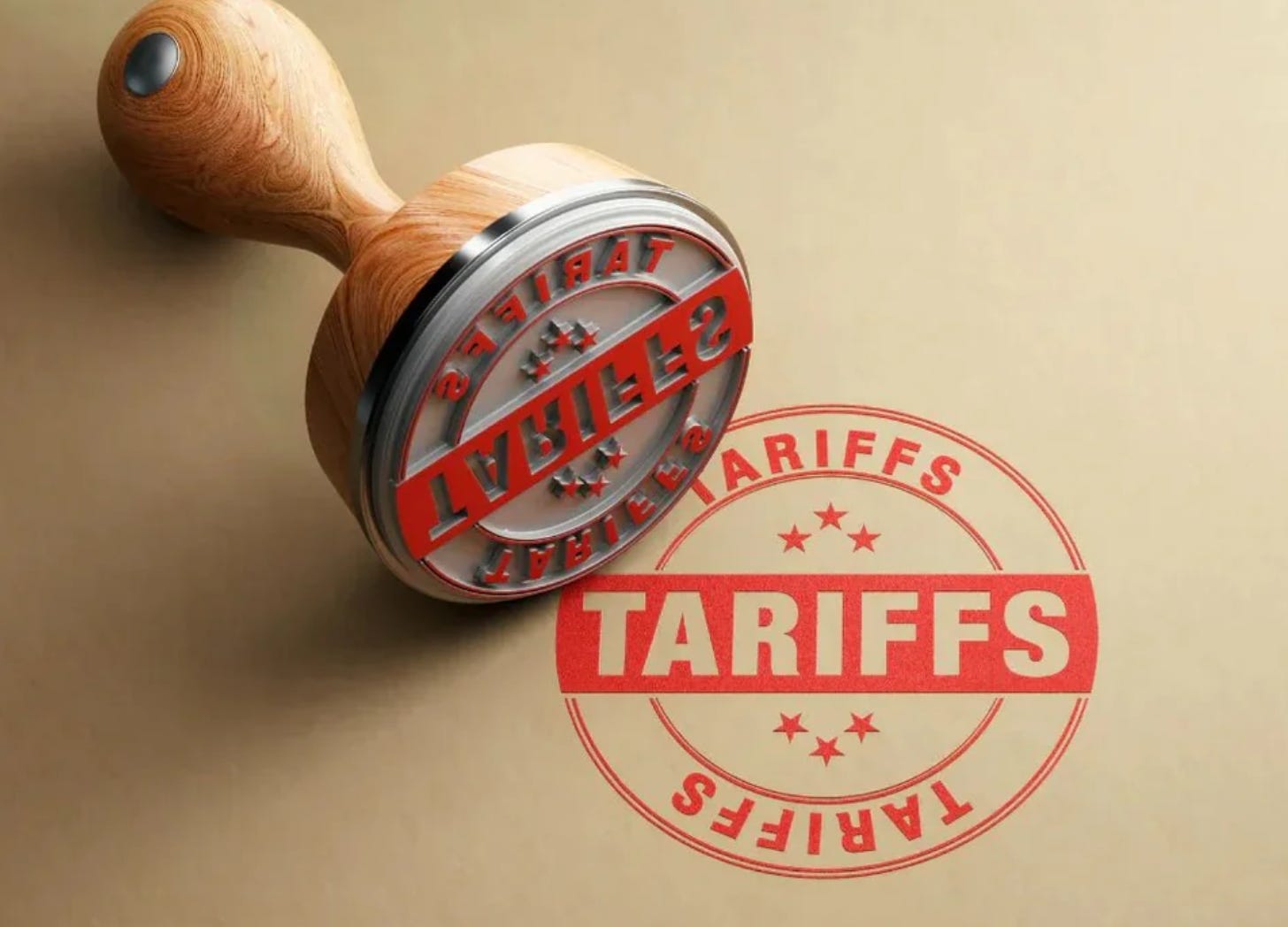
If you’ve noticed your go-to serum quietly creeping up in price, or a beloved moisturizer that seems just slightly different lately, you’re not imagining things. Tariffs are reshaping the global beauty supply chain, and not in the way you might imagine. The full impact is already showing up on retail shelves.
Let’s talk about what’s actually happening behind the scenes, and why price hikes are the least worrisome part.
The Tariff Problem, In Plain English
Okay, let’s break down what’s actually going on, because “tariffs” has become a word that makes people’s eyes glaze over due to the current political climate - that is, until it shows up on a sales receipt.
Import tariffs of 15% or more are now hitting cosmetics and personal care products sourced from the EU and Asia. They supply a huge share of what goes into manufacturing cosmetics: the ingredients, the components that are filled with the formula, and the secondary packaging that sits on retail shelves. Aluminum is also affected, and that one matters a lot, because airless pumps and aluminum tubes are how a lot of high-performance products are now being packaged.
Analysts are forecasting a 12 to 15 percent decline in cross-border beauty trade in the second half of 2026. Mexico, which quietly does a lot of North America’s manufacturing, is stuck in the middle of it: it sources roughly 40% of its packaging plastics and 35% of its specialty chemicals from Asia, and those imports are now facing tariffs of up to 50%.
But what does all this mean? The global machine of suppliers, manufacturers, and logistics partners that makes your favorite moisturizer just got a lot more expensive to run. And nobody designed this system to survive unexpected (unnecessary) tariffs.
Why Prices Are Going Up
The beauty industry was already working with tighter margins than most consumers realize. When raw material costs rise by 20 to 30 percent across the board, brands have a limited number of options.
Absorb the hit (and that’s only the largest companies, not indies).
Reduce fill weights (notice that your favorite serum is now 25ml instead of 30ml?).
Pass the cost on to consumers.
Some have done two, a lot have done all three.
Many prestige brands dependent on components manufactured in France and Italy (Aptar, Albee, Lumson), Korean actives, or aluminum packaging are especially exposed. A high-quality airless pump mechanism sourced from a tariffed region will add significant final cost to every unit manufactured.
But price changes are just the tip of the iceberg.
A Simple Packaging Change Can Be Complicated
The part of this story nobody’s talking about is the part I find most interesting. When a brand has to switch to an alternative component (a different pump supplier, a different bottle, a different tube material), you’d think, well, that’s just a simple behind-the-scenes swap.
It’s not. It has a good chance of changing the formula itself.
Stay with me here, because we’re diving into chemistry. Different packaging materials interact with cosmetic formulas in different ways. Some plastic polymers let more oxygen through, which is a real problem for anything antioxidant-rich. Some eco-friendly materials leach at higher rates over time, introducing the kind of microscopic contamination that affects safety and performance. The pH of a formula can shift depending on what type of container it’s been sitting in for extended periods (months, years). Even a simple pump mechanism matters: it changes how a product gets aerated (allows air in) when you use it, which affects texture, oxidation, and the stability of actives.
None of this is hypothetical. Packaging and formulation are deeply co-dependent, and every cosmetic chemist knows it. You don’t just swap out a new container and call it a day.
The Stability Testing Problem
Here’s where things get genuinely expensive for brands, and genuinely annoying for consumers. Any time a brand changes a component, industry best practice (and regulatory expectations under MoCRA) requires the formula to go through stability testing in its new package.
This is not a quick check. Stability testing requires storage under a range of temperature and humidity conditions for anywhere from three to four months, depending on the formula. This is to confirm it will remain stable from the warehouse to your house in its new container. Accelerated testing can shave some time off that, but it doesn’t make the process disappear. And accelerated testing leaves the door open for formulas to fail once they hit retail shelves.
Picture this: a brand is forced to switch from a Korean-sourced airless pump to a French one. They’re not just eating the cost of the new, more expensive component, they’re staring at months of stability testing before they can confidently put that product back into production. And what happens if the new pump isn’t compatible? They need to keep looking for a compatible component, wasting time and losing money.
In the meantime, they’ve got these options:
Quietly sell through existing inventory without telling you anything is changing, and hope they find a new compatible component that doesn’t leave them out of stock for too long.
Or rush a stability process that shouldn’t be rushed, with a pump that isn’t the best choice for their formula, so there isn’t a hiccup in sales.
Pick your poison. Neither choice is great.
And Sometimes, the Formula Has to Change Too
And here’s the part you’ve noticed, sort of.
Sometimes stability testing reveals that a formula that performed perfectly in its original packaging just doesn’t hold up in the replacement. The new tube reacts with the preservative system. The new pump lets in more air than the antioxidants can handle. The viscosity needs to be adjusted slightly to accommodate the new dispensing system. Small things, but they matter.
When that happens, a brand’s got a choice: hunt for another component and go back for another round of stability testing, or reformulate. And reformulation is no joke. It can mean rebuilding the entire preservative system, adjusting viscosity (reworking the texture), or finding out you need to swap out an active that was specifically chosen to work in the original packaging.
I’ll bet you never thought tariffs could change a formula. Wild, right?
For anyone who’s spent the time (and $$$) finding products that work for their skin, this is not a minor inconvenience. Skin that’s adapted to a specific formula, an actives profile, or a preservative system, can react adversely. And guess what? Brands aren’t required to announce minor formula changes, and neither are retailers. How many times have you seen a disclaimer on an Ulta or Sephora product page, warning you that the ingredient list they have posted could be incorrect, and that you need to check the ingredient list on the physical product you purchased? You might suddenly have a reaction to a product you’ve used for years, wondering why on earth that happened. Well, now it’s YOUR responsibility to compare the ingredient lists to see if that’s why your skin is reacting.
What You Can Actually Do About It
Screenshot the ingredient lists on the products you’re using. If a product works for your skin, photograph the part of the label where the full ingredient deck appears. Future you, confused by an unexpected skin reaction, will thank present you for taking that screenshot.
Watch for the tells: a change in the way the packaging looks (size, shape, decoration), a pump that dispenses differently, a “new look, same formula” callout on the box. Thoughtful reformulation that attempts to emulate the original formula as closely as possible can take months, and stability testing can expand that time frame to a full year. A brand quietly navigating a packaging swap while keeping the product safe is doing the responsible thing, even when its communication about it leaves a lot to be desired. So, please give those brands a little grace on timing.
#MyTwoCents
Here’s what nobody in the industry wants to say out loud: the beauty supply chain has been running on the assumption of frictionless globalization for decades. Ingredients from one continent, packaging from another, manufacturing from a third, all assembled into a product that lands on a shelf in your city at a price point that somehow still includes a margin for everyone involved. That model is under real pressure right now, and tariffs are accelerating a restructuring that was probably inevitable anyway.
The brands best positioned to navigate this are the ones who’ve invested in ingredient flexibility, domestic or regional sourcing relationships, and transparent communication with their customers. The ones who are going to struggle are the ones who’ve been running lean on single-source dependencies, hoping the trade environment stays cooperative.
For consumers, the reality is: the products you love are going to cost more, some of them are going to change, and a few of them might disappear entirely while brands figure out an alternative. That’s not me being an alarmist. It’s simply facts.
The best thing you can do is stay informed, pay attention to your products, and not assume that a higher price tag means the brand is trying to take advantage of you. In 2026, it might just mean the pump got more expensive.
What do you think? Let’s have a conversation in the comments.
Kevin James Bennett is the publisher of In My Kit®. He is an Emmy Award-winning makeup artist, cosmetic developer, educator, and consumer advocate. Learn more at www.kjbennett.com