


Saying the cosmetic industry is oversaturated is an understatement; since the surge in skincare sales during the COVID lockdown, the category has spiraled out of control.
Walk into any major beauty retailer, and you’ll find shelves bulging and overflowing with serums that promise to change your skin overnight, moisturizers with ingredient lists longer than a celebrity pre-nup, and eye creams priced like a Birkin that are no more than a basic moisturizer in a smaller jar.
We’ve been conditioned to believe that slick marketing full of technical terms signals sophistication, and that a $300 price tag means the formula inside is doing something extraordinary.
Spoiler Alert: It usually isn’t. (looking directly at you, Dr. Barbara Sturm 🤨).
So when a brand has the audacity to say “fewer products, better formulas, real transparency,” it either earns serious respect or gets lost in the noise.
DIEUX has done the former (in my opinion). It has built a loyal, informed customer base and become one of the most talked-about brands in modern skincare - not because of slick marketing, not because a celebrity is fronting it, but because it actually does what it says it does.
That’s worth talking about, so let’s get into it.
The Founders
DIEUX launched in September 2020, right in the middle of a global pandemic — which, in retrospect, is either terrible timing or perfect timing depending on how many skincare TikTok rabbit holes you fell down during lockdown. The brand was built on two distinct but deeply complementary areas of expertise, and that pairing is the foundation of its success.
Charlotte Palermino is the brand’s Co-Founder and Chief Brand Officer, and if you follow anyone on TikTok who talks about skincare, without lying, you’ve probably encountered her. She’s a licensed esthetician with a background in media, marketing, and editorial, having spent years as an editorial director building and scaling digital audiences for some of the world’s biggest media brands before pivoting to skincare.
Before DIEUX existed, she was already running a newsletter called Nice Paper, debunking beauty myths, interviewing scientists, and building an audience that expected substance over spin. Her social media presence grew from that same foundation: genuine skepticism, science explained in plain language, and no particular interest in telling you what you want to hear. That made her a credible voice long before she was a brand founder.
Joyce de Lemos is the Co-Founder and Head of Product, a clinical cosmetic chemist with a Master’s in cosmetic science and a résumé that spans L’Oréal’s suncare division, COSMAX (one of Korea’s most formidable contract manufacturers), Kiehl’s, and SkinCeuticals. At SkinCeuticals, she was part of the team that developed the iconic Triple Lipid Restore 2:4:2 — a project that took nearly four years to complete, with an entire year devoted to the approval of a single ingredient. That’s the level of rigor she brought to DIEUX. Her presence as a co-founder is not cosmetic (no pun intended). It means the person asking hard questions about ingredients and efficacy is also the person in the lab developing the formulas. That closed loop matters more than people realize.
These two extremely intelligent, passionate people were genuinely frustrated with the state of skincare. The outcome of that frustration is the incredible standards they’ve set for every product decision they make.
The DIEUX Philosophy: Edit Your Routine, Not Your Standards
DIEUX operates on a thesis the industry finds quietly threatening: you don’t need more products, you need better ones. In a category where growth is traditionally measured by SKU count and the relentless onslaught of new launches, that’s a radical position. It’s also the correct one.
The brand’s approach centers on what they call a “moisture wardrobe”, based on the idea that your skin’s needs shift depending on season, climate, and circumstance, and that a small, thoughtfully curated collection of products can address all of those variables without requiring a twelve-step routine. This isn’t minimalism for minimalism’s sake. Its efficiency is built on clinical rigor.
Every DIEUX product undergoes clinical vetting before reaching the market. Claims are tested. Formulas are iterated, often through dozens of versions, before one is approved. When your Head of Product spent four years developing a single moisturizer at SkinCeuticals, “good enough” isn’t part of the vocabulary.
The DIEUX Products: What Doing More With Less Looks Like
Forever Eye Mask ($25.00 USD) was the product that put DIEUX on the map, and it’s a fascinating choice for a debut because it’s not a serum or a moisturizer - it’s a reusable silicone under-eye patch built to replace the avalanche of single-use under-eye masks filling trash cans.
The concept is almost insultingly simple: one pair of medical-grade silicone patches that you rinse, dry, and use again. No active ingredients, no fragrance, no drama. Just occlusion, forcing your skin to absorb more of whatever serum or moisturizer you’ve applied under it. They’ve since collaborated with brands like Violette_FR and Eckhaus Latta on limited edition versions, but the original premise hasn’t changed. It’s a sustainability play that actually works, which is truly refreshing in a category full of greenwashing claims that don’t hold up to scrutiny.
Deliverance ($69.00 USD) is their serum, showcasing Joyce’s undeniable expertise in formulation. It’s a 3-in-1 repair serum that picked up an Allure Best of Beauty nod in 2025. This lightweight but potent multitasker soothes inflamed skin on contact, targets fine lines and wrinkles, and visibly smooths skin texture and tone. The peptide complex comes in at 5% total: 2% N-Prolyl Palmitoyl Tripeptide-56, clinically studied for visible firmness and reducing fine lines, alongside 3% Palmitoyl Hexapeptide-52, a blend of passionflower, white tea, and peptides shown to reduce the appearance of expression lines. A 1.4% encapsulated cannabinoid complex (CBD, CBG, and CBN) addresses redness and irritation, and 4% niacinamide handles tone correction. The encapsulation detail matters: these aren’t trend ingredients sprinkled in at trace levels to earn a spot on the label. They’re stabilized for actual delivery. That distinction is rarer than it should be.
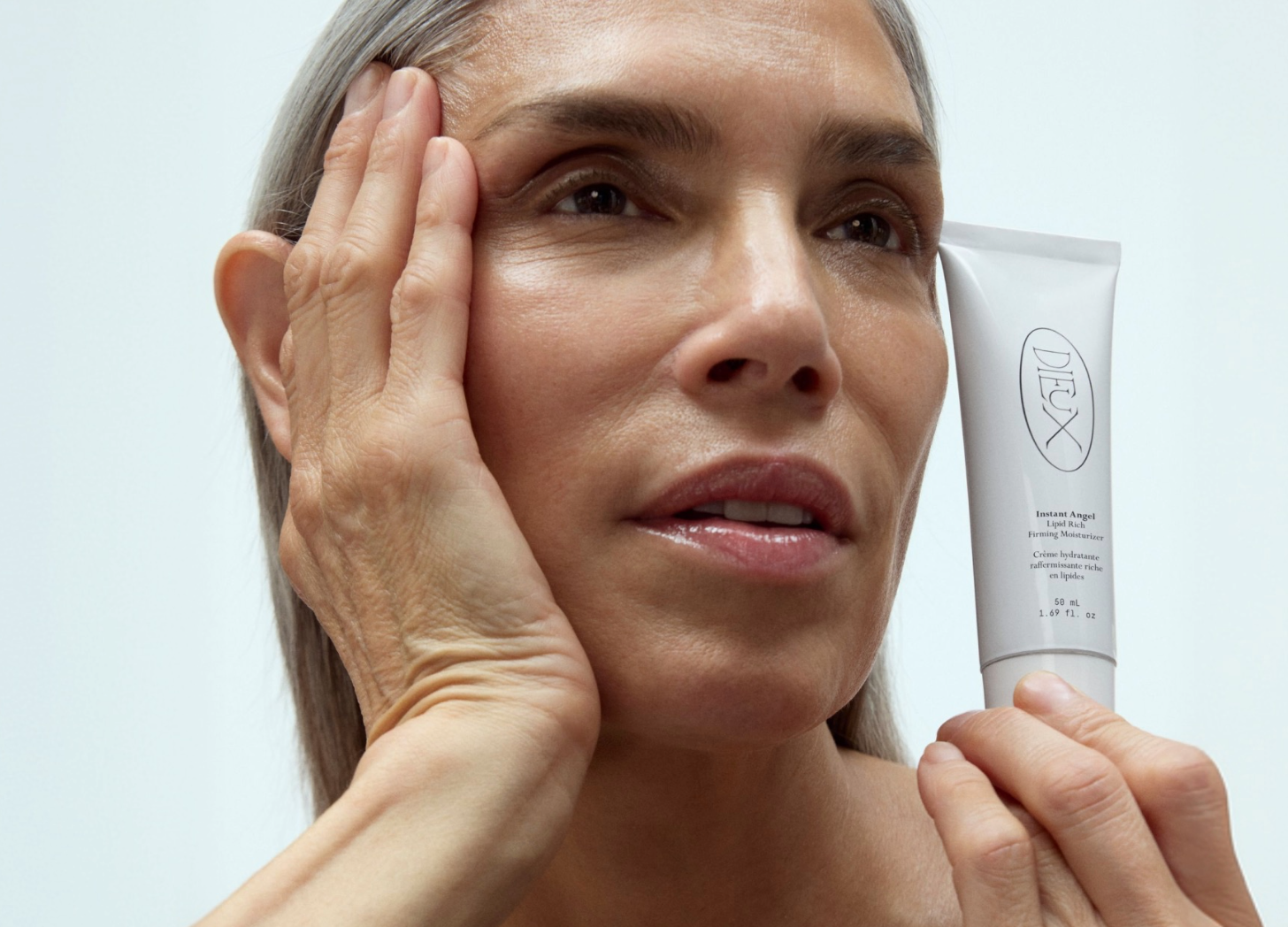
Instant Angel ($45.00 USD) is the “hero” moisturizer, and it became a cultural moment when Hailey Bieber mentioned it in a 2022 skincare video, and the internet briefly lost its mind. The formula, though, was doing interesting work long before any celebrity co-sign turned it into a sellout. It’s built on a hydrolipid blend — phytosterols, free fatty acids, ceramide NG, glycerin, urea, squalane, sodium PCA, and meadowestolide — designed to mirror the composition of the skin’s own lipid barrier. This isn’t a moisturizer that makes your skin feel temporarily smooth. It works with your skin’s biology to rebuild what’s actually depleted.
If that sounds familiar, it should. As I mentioned earlier, Joyce was part of the team that built SkinCeuticals’ Triple Lipid Restore 2:4:2, long considered one of the gold standards in barrier repair and currently retailing at $155 for 1.6 oz. (more than triple the price of a similar-sized tube of Instant Angel).
Instant Angel is her modern evolution of that concept: more sophisticated, more refined, and priced at a fraction of what dermatology offices charge for its predecessor. You’re getting the chemist who helped create the benchmark, this time without the luxury markup.
Air Angel ($34.00 USD) is Instant Angel’s lighter counterpart, now formally called the Peptide Plumping Gel Cream. It shares the same hydrolipid framework but is calibrated for oilier or acne-prone skin, as well as humid climates. Clinical testing on acne-prone skin confirmed it doesn’t trigger breakouts or compromise the barrier.
Creating two versions of a moisturizer that address the same skin concerns, but are tailored to skin types, means you’re not missing key attributes from one formula to the other. You’re offered thoughtfully formulated variations based on the same core principles, which you can interchange as your skin’s immediate needs change. That’s SMART product development.
Auracle Eye Serum ($44.00 USD) arrived around the same time as Air Angel. It’s DIEUX’s dedicated eye treatment, formulated specifically for the delicate orbital area and designed for maximum results when applied under the Forever Eye Mask for a 10-minute intensive under-eye treatment.
The formula is a lightweight gel-serum with active ingredients at clinically studied doses: 1% Algae Polysaccharides Complex to visibly reduce the appearance of dark circles, 1% Algae Complex to smooth skin and reinforce its integrity, 3% Palmitoyl Tripeptide Complex to reduce puffiness and reinforce firmness, and 10% Glycerin for deep hydration.
Ethereal Cleansing Oil ($28.00 USD) is DIEUX’s cleanser for dry and sensitive skin, and a first-step cleanser for normal, combo, and oilier skin types. The formula tells you a lot about how they approach product development. Just seven ingredients - an Instant Dissolve Complex of emollient oils that melt waterproof makeup and SPF on contact, and a Double Cleanse Emulsifier Complex that allows the whole thing to rinse clean with water, leaving zero oily residue. This is important in a category full of cleansing oils and balms that just smear your makeup and SPF around, leaving a film unless you use a washcloth to remove them. Ethereal Cleansing Oil actually rinses clean, taking all the debris with it. The simplicity of the formula is kind of amazing.
Baptism Gel Cleanser ($34.00 USD) is a stand-out foaming gel cleanser built around Glycerin, Betaine, and Glycolipids — surfactants that remove makeup, sweat, and SPF without stripping the skin’s barrier or impacting your skin’s healthy pH. It’s formulated at a pH of 5.5, which is deliberate because it mimics the skin’s natural slightly acidic pH range (4.5 to 5.5). Many foaming cleansers disrupt your skin’s pH and leave it in an alkaline state - unbalanced and prone to irritation. Skin in an alkaline state is also forced to rebalance itself, and until it gets back to a comfortable pH, it ignores any skincare you apply.
Baptism is also ophthalmologist-tested, so it’s safe for removing eye makeup. That’s a lot of boxes checked for one cleanser.
Skin Mercy Recovery Cream ($38.00) is the third piece of Dieux’s moisturizer trinity. It’s a colloidal oatmeal recovery cream built specifically for sensitive and eczema-prone skin. At 1% colloidal oatmeal, it meets the FDA’s standard as a clinically proven OTC skin protectant. This is the product you reach for when your skin is irritated, sensitized, and your barrier is compromised. This formula was created with intention, not as an afterthought, trying to appeal to the current barrier balm trend.
Skin Mercy completes the warbrobe of Dieux moisturizers, thoughtfully formulated to address all your skin’s moisturizing needs, flowing seamlessly from one to the other - and always delivering the results promised.
Transparency as a Business Model
Here’s where DIEUX does something most brands talk about and almost none actually execute: real pricing transparency. On every product page, they break down exactly where your money goes — formula costs, packaging, labor, warehouse and shipping, and payment processing fees. All of it, in real numbers. You can see what the product costs to make and how the retail price was arrived at.
This isn’t a marketing tactic. It’s a structural commitment to the consumer relationship, and it fundamentally changes the conversation. When a brand shows you exactly what something costs to produce, they’re telling you the formula is doing the work — not the markup. That accountability is baked into the model by design.
The transparency extends to sourcing and ingredient provenance. DIEUX vets its suppliers’ labor practices, adheres to European regulatory standards for formulation (which are stricter than U.S. standards in several meaningful ways), and maintains a fully vegan and cruelty-free supply chain.
These commitments aren’t buried somewhere on a FAQ page. They’re woven into how the brand presents itself at every level.
Sustainability That Actually Means Something
The Forever Eye Mask is the most visible example, but DIEUX’s sustainability commitments run deeper than one hero product.
You can read their “Commitment To Making Better Trash™” HERE.
Their planned skincare studios in New York and Los Angeles for 2026 will include refill stations and upcycling labs — a signal that reducing waste is a long-term operating principle rather than a launch talking point. Interactive ingredient workshops led by their in-house formulation team will give consumers a more direct line to understanding what’s actually in what they’re buying, and why it matters.
Their development lab in Brooklyn’s Dumbo neighborhood is already working on what may become the most consequential product in the brand’s history: sunscreen. They’re experimenting with Parsol Shield, a chemical filter with FDA approval expected as early as June 2026 — which would make it the first new sunscreen filter approved for U.S. use in more than 25 years. They’re also developing nano zinc-based formulations for consumers with allergies to chemical filters. DIEUX approaching SPF with the same clinical rigor they’ve applied to everything else is a significant development in a category that has historically underdelivered on texture, inclusivity, and innovation in the U.S. market. If anyone is going to fix American sunscreen, these are the people I’m betting on.
#MyTwoCents
I have spent a significant portion of my career watching brands promise transparency and sustainability while delivering nothing more than marketing spin, mediocre formulas, and greenwashing to sound eco-conscious.
DIEUX does not do that, and I think it’s worth having a conversation about why that matters.
The skincare industry is crowded with brands built around a story first and a formula second. DIEUX inverted that model. The formula comes first, the story follows, and the transparency isn’t a marketing campaign - it’s the whole architecture of the brand. This business model is much harder to build and sustain, and the fact that they’ve done it so successfully while cultivating genuine consumer loyalty says something important about where the skincare market is headed.
Consumers have become much smarter than brands give them credit for. When a brand shows you exactly what your $69 serum costs to make, offering a genuinely sophisticated formulation, with clinically supported claims, and packaging designed to reduce waste, THAT builds incredible trust.
Many inside the industry label this as disruptive, but since when has HONESTY been disruptive? This business model should be the norm, not an anomaly.
FACT:
DIEUX has figured out how to future-proof their brand, and the rest of the industry should be taking notes - or get left behind.
What do you think? Let’s have a conversation in the comments.
Disclosure: This article is not sponsored, and no compensation was received from DIEUX or any affiliated party. There are no affiliate links in this piece. All product links go directly to the brand’s website at dieuxskin.com.
Kevin James Bennett is the publisher of In My Kit®. He is an Emmy Award-winning makeup artist, cosmetic developer, educator, and consumer advocate. Learn more at www.kjbennett.com
I love Dieux and its founders, Charlotte Palermino and Joyce de Lemos. It’s rare to see a beauty brand lead so unapologetically with science and transparency. I especially appreciate their willingness to call out greenwashing and challenge misinformation surrounding organizations like the Environmental Working Group. Palermino’s commitment to social justice also makes the brand stand out — she rejects the outdated idea that beauty companies should “stay in their lane” and instead recognizes that values and advocacy matter. On top of all that, the products themselves are genuinely exceptional. Thank you for this great post, Kevin.
So good! You turned me on to the silicone eye patch and eye cream and I love them both. You are such an amazing resource.