


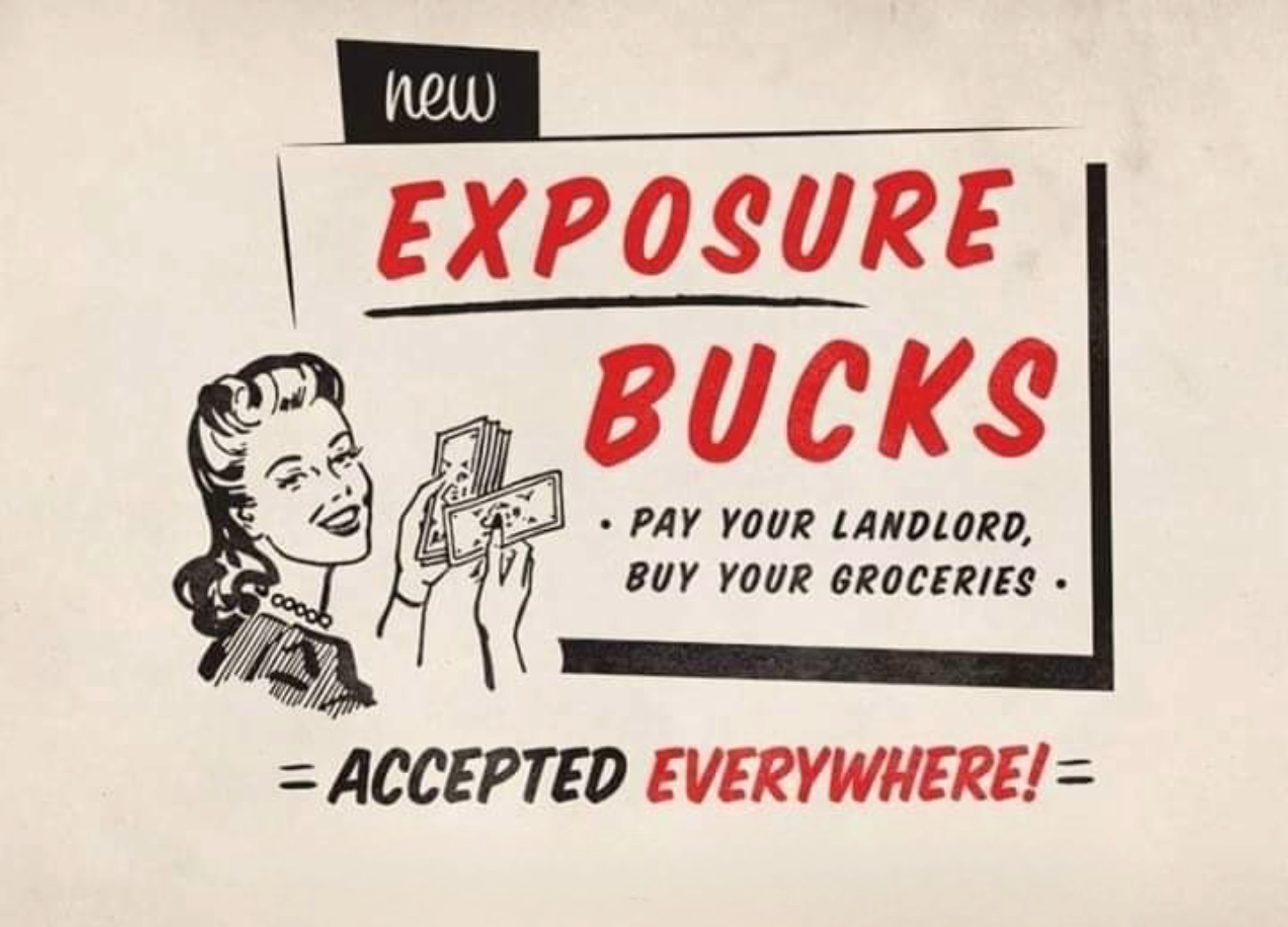
Let’s talk about something that happens to professional makeup artists with alarming regularity. A photographer, a production, a brand, or a celebrity requests our skills, time, and resources. In exchange, we’re not offered a fair rate, we’re not offered payment at all - we’re offered “exposure” as compensation.
If exposure paid the rent, I would have been living in a luxurious Manhattan penthouse decades ago.
Let’s Define Who We Are
A professional makeup artist is someone whose “profession” is applying makeup to others as a primary source of income. Not applying makeup to ourselves. Applying makeup to PAYING clients.
We invest in training and building our first working kit. We build a resume, a portfolio, and a client base. We develop a reputation in the industry. Lawyers, doctors, and other trade workers do the same - they invest in training and the tools required to be paid for their services.
We’re no different.
Yet there’s an interesting disconnect: nobody debates whether someone is a “professional” lawyer or a “professional” doctor. You don’t become a lawyer or doctor by cosplaying one on social media. There’s only one path: education, apprenticeship, and enough experience to justify charging for your services.
But the profession of makeup artist is perceived differently.
Social media changed that.
Beauty influencers and content creators apply makeup to themselves on camera, while identifying as makeup artists without the training, investment, or working experience that qualify someone to charge for these services. They demonstrate makeup application on their own faces, making it look simple and accessible - something anyone can do. But applying makeup to yourself and applying it to paying clients with diverse face shapes, features, skin tones, and skin types requires a completely different skill set.
Reality Check: Becoming a member of the Makeup Artist profession requires significant financial investment, training, and work experience, so that applying makeup to paying clients can become a primary source of income. PERIOD.
When people without those qualifications use our professional title, it fundamentally weakens the industry’s understanding of what we do. They’ve framed makeup as entertainment or a hobby instead of a skilled trade. And that perception directly impacts our ability to demand fair compensation. Because if applying makeup looks that simple, why should you be paid?
Your Work Is Part of The Vision, And It Has Value
When someone asks you to work for free, they’re asking you to subsidize their project at your expense. They’re asking you to use your professional expertise to create a fundamental part of their final product.
Look at a feature article in a lifestyle magazine (print or online). The photographer and art director set the tone for the story. What’s in it? The model or celebrity’s face, skin, hair, and makeup. Our work is not an inconsequential decoration; it is part of the storytelling. The publication is paying for the creation of this image. And your work helped turn the concept into a reality. You deserve to be paid.
Look at a red carpet. The celebrity is the focus. The makeup is reported on and often emulated. Your contribution is not optional - you are part of the creative process. You deserve to be paid.
Look at a commercial, TV show, or film. Production has a storyboard that maps out a vision, including how the actor(s) look. Makeup isn’t an optional detail; it’s part of what the director and producer have envisioned and approved. You deserve to be paid.
When you’re contacted for a project and told makeup isn’t budgeted for, they’re probably lying. They wouldn’t be requesting your talent on their project if your contribution weren’t an important part of the finished product. They need you, while pretending your contribution is optional.
The Hypocrisy Is Built In
Here’s where the hypocrisy becomes infuriating: the people asking you to work for free are getting paid.
A photographer reaches out to book you for a shoot and says, “We have no budget for makeup, but you’ll get a credit and exposure.” Ask the same photographer if they’re shooting this for “credit and exposure”. Doubtful.
That photographer is charging the client. They’re making money. Yet you’re supposed to work for free?
A celebrity’s manager or publicist requests that you do their client’s makeup for a red-carpet event or press tour - for free. They frame it as though the “honor” of working on their famous client is compensation enough. But aren’t they paid by the celebrity for their work? Yet you’re supposed to work for free?
Association with famous people is not currency. It’s not compensation. You should be paid.
Ask a lawyer for 40 hours of legal work for free in exchange for “exposure”.
The answer will be NO, followed by a side-eye and an incredulous chuckle. No explanation needed. Professional services cost money. Skilled work requires compensation. And a lawyer, even one who only recently passed the bar exam, is paid as a law clerk while they build their career. They respect their investment and demand compensation for their work.
The person requesting your services is being paid. They’re disrespecting the investment you’ve made to be qualified for this work. Why do they assume you’ll work for free?
The Investment They Intentionally Ignore
A career as a professional makeup artist requires an investment of tens of thousands of dollars just to get started. That investment deserves respect. Your compensation isn’t greed - it’s honoring what you’ve already invested in yourself.
Once your career is in motion, a professional makeup artist is continuously reinvesting.
Products get used up, disposables end up in the trash, tools wear down, break, or become outdated. We as professionals are required to constantly replenish, replace, and update our kits. My two makeup kits, an SFX kit, brushes, tools, ancillary products, disposables, lighting, etc., are insured for $250,000.00 - because that’s what it would cost to replace what I’ve built over decades of work.
When someone asks you to work for free, they’re asking you to absorb the cost of your time, your talent, and your materials. They benefit while you work at a deficit. They’re asking you to disrespect the investment you’ve already made in becoming qualified to do this work.
This Has Become Systemic
This isn’t accidental. Photographers and producers didn’t “forget” to budget for makeup. They’ve coded our work in the spreadsheets as non-essential and less worthy of compensation.
A photographer charges thousands for a single shoot (sometimes tens of thousands). A director negotiates a contract with a substantial payout. But when that same group of creatives has to budget for makeup, suddenly there’s no more money. Suddenly, your contribution is considered optional or of little value.
It’s not because your work is less important. It’s because the industry refuses to categorize it for what it is - integral to creating the finished product. And the “exposure” argument is the industry’s longest-standing scam. They continue to use it because they’ve been getting away with it for far too long.
Exposure only works as compensation if it actually leads to paid work…
It rarely does.
Typically, when the next paying gig comes up, they hire the person who refused to do the gig you did for free. That person has made it clear that their contribution is valuable. You took the risk, worked for free, hoping for a break, and then the artist who refused to be taken advantage of is rewarded.
It sucks, but that’s reality.
You’re Not Being Difficult, You’re Just Saying NO
This is the part most makeup artists don’t realize - you’re allowed to say no.
There are too many high-profile makeup educators who scare artists into accepting free work, claiming it’s the only way to build a career. Many of these trusted educators have an agenda - but I’ll discuss more about that in another article.
But even more than that, if others on the same project are being paid, you MUST say no to working for free.
Every time a professional accepts free work, knowing others are being compensated, you’re telling the industry that your contribution is worthless. You’re agreeing that your skills, your investment, and your years of experience don’t deserve proper compensation. And when you agree to that, it becomes impossible for every other professional makeup artist to request fair rates.
By accepting free work, you’re not just devaluing yourself. You’re devaluing our entire profession.
If they claim they can’t afford to pay you, politely turn them down and tell them you’d love to work with them - when they have a budget. That’s not shady, that’s business.
If they push back, call you difficult, or expect gratitude for offering you the “opportunity”, you know what you’re dealing with: someone who doesn’t respect your skill, doesn’t value your time, and isn’t worth working with.
To the New Professionals
If you’re early in your career and you’ve already said yes to free work (for exposure, for a credit, for the experience), I’m not here to make you feel bad about it. Starting out is hard. You’re building your portfolio, making connections, trying to prove yourself.
You’ve invested time and MONEY in your commitment to joining this profession. That investment deserves compensation. Not someday. TODAY.
You deserve monetary compensation for your work. Not exposure. Not line credits. PAYMENT. Because accepting fair payment isn’t about greed, it’s about respecting the investment you’ve made to become qualified to do this job in the first place.
By insisting on being paid for your work, you’re telling the industry that you understand your own value. And that clarity protects this profession for everyone who comes after you.
#MyTwoCents
When a production company contacts a photographer, a director, or a set designer, they aren’t asked to work for free. Everyone knows: professional work requires payment.
Professional makeup artists deserve the same respect. We’ve spent years building our careers and honing our craft. We provide skills that are necessary, not optional.
The question isn’t about our value. We know our value. The question is: why do people (who know better) feel justified in disrespecting us and devaluing our contribution?
Set your rates, and NEVER apologize for your worth.
Exposure doesn’t pay the rent or put food on the table - a fair rate does.
Kevin James Bennett is the publisher of In My Kit®. He is an Emmy Award-winning makeup artist, cosmetic developer, educator, and consumer advocate.
Learn more at www.kjbennett.com
This article touches my soul and feels like a cry that has often prevented us from shouting these words too truly. The further we go, the more social media confuses roles. But as you say, it's up to us to say NO to a manipulation that risks making us waste years and time dedicated to what is crucial for us to remain credible in a job that isn't yet recognized as such. Allow me to tell you that I will expand this content to give a voice to all of us in the sector. Thank you infinitely.❣️
Thank you for this. I am not a make-up artist, but as an Acupuncturist I have been asked to work for free. I hae been shamed and embarrassed when I said no. It is so hard. I spent a ton of money on my profession. I appreciate your words. :)