


Thirty-one million Americans are now on GLP-1 medications, and for most people, it genuinely works.
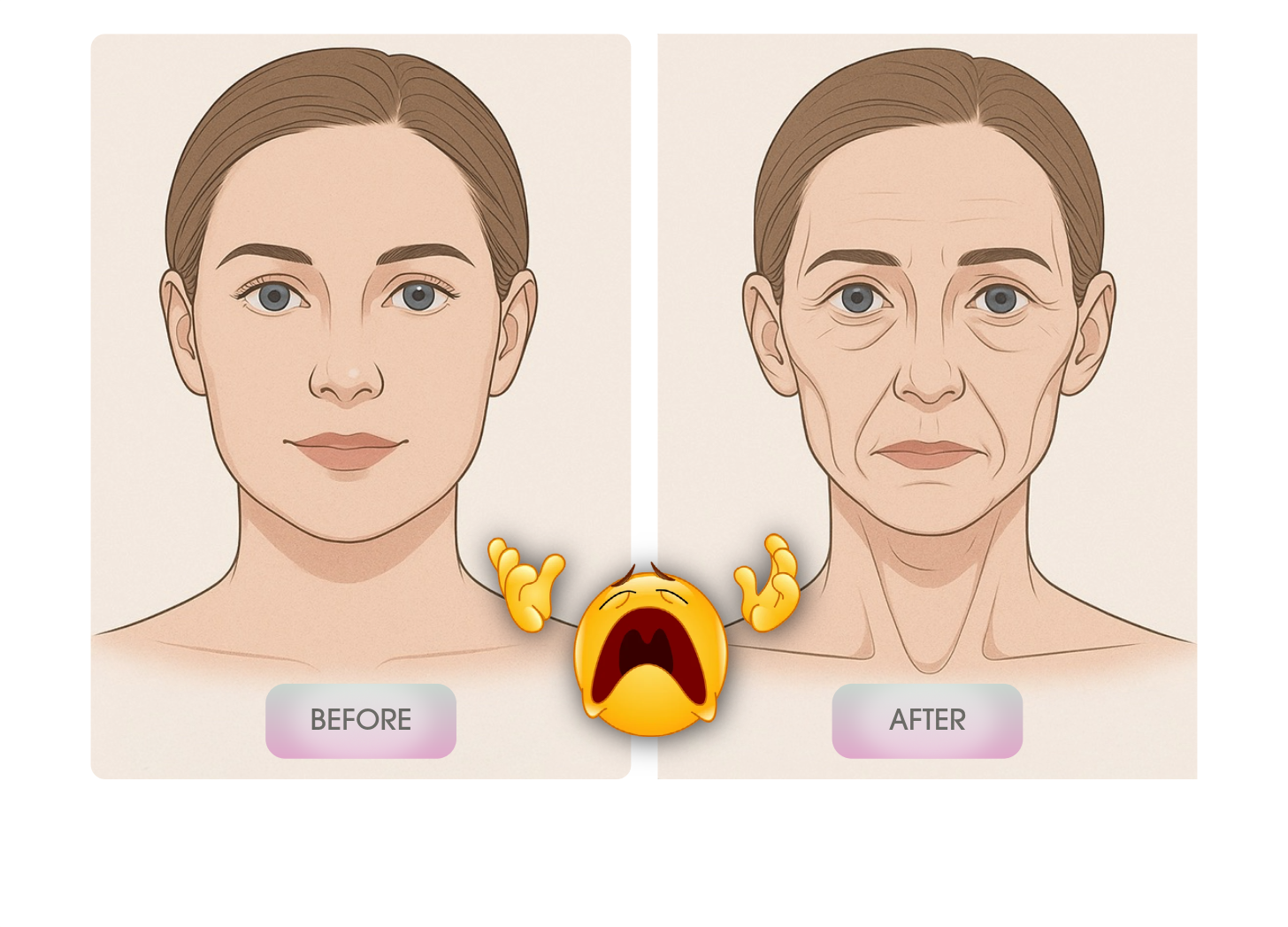
But somewhere along the way, as their new streamlined bodies began to emerge, something else began to happen. Their face wasn’t just getting thinner, it was beginning to look drawn - older!!! 😳
Temples caved in, cheeks and undereyes hollowed out, and jaws got slack. The skin all over their body began to look looser, crepey, and stopped snapping back the way it used to. They were losing weight, but they were also losing skin vitality - from head to toe.
The problem eventually got a nickname, “Ozempic Face”. But the nickname is misleading because the changes don’t stop at the jawline. The same thing was happening to necks, arms, abdomens, thighs, and butts. Head to toe, skin quality was changing - for the worse. And now the beauty industry is tripping over itself, trying to figure out how to address it.
What’s Actually Happening to the Skin
This isn’t your typical weight-loss side effect. It goes a lot deeper than that.
Rapid weight loss has always come with some skin laxity. That’s not new. What is new is what GLP-1 drugs appear to be doing beneath the surface. Research published in the Aesthetic Surgery Journal found GLP-1 receptors sitting directly in the skin tissue responsible for producing collagen, elastin, and hyaluronic acid. The drugs appear to disrupt those cells’ ability to do their job, essentially telling your skin’s repair system to kick back and take a break.
Dr. Sabrina Fabi, a board-certified dermatologist and cosmetic surgeon, put it plainly: “Your skin cells are not readily able to regenerate fat or dermis when you are on these medications.” Dr. Rishi Chopra, a board-certified New York dermatologist who presented on this at the 2025 ASDS annual meeting, is seeing the same thing: “I’m very surprised at the level of laxity and significant volume loss and sagging that we’re seeing in GLP-1 patients.”
So when someone says their skin “looks different” since starting a GLP-1, they’re not imagining it. The drug itself may be actively aging the skin at a cellular level. And that’s a “problem” the beauty industry is happily building an entire product category around.
The Specialists Who Never Expected to Get This Busy
Nobody walked out of their primary care physician’s office with a GLP-1 script, PLUS a referral to a facial plastic surgeon. And yet, here we are.
Dermatologists’ and plastic surgeons’ offices are struggling to accommodate a massive group of patients they weren’t expecting. More than 20% of one prominent dermatologist’s patient base is now on these medications, many of them showing up specifically to address what the drug did to their face and body. Facial fat grafting procedures were up 50% in 2024, according to the American Academy of Facial Plastic and Reconstructive Surgery, driven largely by GLP-1 patients.
The stat that really puts this into perspective: 63% of GLP-1 patients now seeking facial treatments have never set foot in a dermatologist’s office or a medispa before. They’re first-timers, arriving confused, often alarmed, and under-informed. The conversation with their GLP-1 prescriber covered the physiological side effects of the drug, but never included, “by the way, in a few months you may want to call a dermatologist and a plastic surgeon.”
These side effects are causing a windfall $$$ for the aesthetics industry. A Galderma study found that over 91% of dermatologists and plastic surgeons recommend a combination of Sculptra and Restylane to someone dealing with it. For more severe cases, fat grafting delivers long-lasting, natural-looking results at an even higher price. The waiting rooms are full, the referrals are pouring in, and dermatologists and plastic surgeons have become the cleanup crew for a problem that started in a completely different doctor’s office.
The Products (And What to Actually Think of Them)
Predictably, the cosmetic industry saw an opportunity and jumped in fast. Whether they belong here is a different question.
Products appearing on shelves right now range from “genuinely formulated for GLP-1 skin laxity” to “we had an anti-aging serum and decided to slap GLP-1 on the label.” Let’s look at a few products getting the most attention.
NOTE: None of them has independent, third-party clinical data to back up their claims.
DermaReverse by Dr. Few Skincare has the strongest study design: a split-face, placebo-controlled, blinded pilot study on 7 GLP-1 users, published in the Aesthetic Surgery Journal Open Forum, in which 100% of participants saw improvements in skin laxity, texture, and transdermal moisture loss over 6 weeks. At $300 for 30ml, it’s not cheap.
But here’s what the brand’s marketing conveniently skips: Dr. Few and his COO co-own Aforé LLC, the company that makes DermaReverse. The man running the research owns the brand being tested. That’s a founder studying his own product, not independent validation.
Peer-reviewed? Yes. Third-party validation? No.
VOL.U.LIFT by Image Skincare launched in April 2025, built around what co-owner and board-certified plastic surgeon Dr. Marc Ronert calls the “Four D’s” of GLP-1 skin changes: deflation, deep wrinkles, dehydration, and density loss.
A 12-week study with 29 participants showed more than 20% improvements in volume, elasticity, firmness, and hydration. That study was funded directly by Image Skincare. Published in a peer-reviewed journal.
Peer-reviewed? Yes. Third-party validation? No.
SkinCeuticals A.G.E. Interrupter Ultra Serum arrived in August 2025 from L’Oréal, and this is where things get the murkiest. The headline numbers in the marketing (up to 18% visible lifting and 54% improvement in smoothness) come from testing on 76 people who were NOT on GLP-1 medications. The actual GLP-1 patient testing involved 25 people and included ultrasound procedures, making it impossible to know what results were contributed by the product and what results came from the ultrasound treatments.
No peer-reviewed publication. No third-party testing. It’s all internal L’Oréal data, released via a press release.
So there you have it. Three “frontrunners,” all backed by in-house, brand-funded data, no independent researchers, no third-party validation. That doesn’t automatically make them bad products. It means you’re buying on faith, not evidence.
Then there’s everything else — and “everything else” is a lot of existing anti-aging products dressed up in new packaging with a GLP-1 callout slapped on it.
Cosmetic chemist Ron Robinson said it plainly: most of the ingredients in these launches aren’t new. They’re the same anti-aging staples that have been on shelves for years. Two years passed between “Ozempic Face” entering the cultural conversation and the first products hitting the market. Plenty of time to develop something genuinely innovative and effective to address the problem.
Also, plenty of time to rebrand an existing product (with minor tweaks) and relaunch it as a product developed specifically for GLP-1 users.
The only way to tell them apart is to check whether the testing was actually done on GLP-1 users, not just people with general skin-aging concerns.
The Ingredient Everyone’s Suddenly Obsessed With
Let’s talk about Volufiline™ for a minute, because it keeps showing up everywhere, and the marketing pitch is interesting enough to deserve an actual conversation, not just a dismissal.
Volufiline is a patented ingredient that works on fat cells, which is exactly why it sounds relevant here. Instead of targeting collagen, elastin, or hyaluronic acid, as most anti-aging ingredients do, it targets fat cell development, nudging cells to mature faster and store more lipids. Essentially asking the skin to plump itself from within. Given that Ozempic Face isn’t just about fat loss but also about the body’s impaired ability to regenerate fat cells, an ingredient that works at that level is at least addressing the problem.
But here’s where it gets sketchy. The clinical study behind Volufiline was conducted by Sederma, the company that makes it. It showed a 2.2% average increase in volume after 56 days of twice-daily application. And it was done on breast tissue, not the face.
ZERO clinical trials have examined Volufiline specifically in GLP-1 patients. ZERO. The mechanism is plausible. The claim that it reverses Ozempic Face? That’s not science, it’s storytelling.
When you see Volufiline listed as the hero ingredient in a GLP-1-targeted skincare product, the brand is basing its marketing on a small, self-funded study conducted on a completely different part of the body. 🤨
It’s Not Just the Face
“Ozempic Face” is a catchy name, but limiting this conversation to the face is like referencing the tip of the iceberg while ignoring what’s underwater.
The same thing happening to your temples and cheeks is happening everywhere else, and for many GLP-1 users, the body is where the changes are most jarring. When subcutaneous fat disappears faster than the skin can adapt, everything that once had structure and support underneath it suddenly doesn’t. Upper arms go crepey. The abdomen, which may have been the whole reason someone started the medication in the first place, ends up loose and deflated instead of smooth and tight. The same problem appears on the neck, arms, thighs, and buttocks.
And unlike the face, these areas are harder and more expensive to treat. Multiple rounds of energy-based treatments such as radiofrequency, ultrasound, and laser are being offered to address post-GLP-1 body laxity. For more severe skin laxity, surgical body contouring is booming.
Age is the other variable that seems to be getting ignored. Someone in their 30s rapidly losing 30-50 pounds has a decent shot at a reasonable skin rebound. Someone in their 50s or 60s losing the same amount of weight is dealing with skin that already has compromised collagen and elasticity production. Rapid fat loss on top of that is a completely different situation. Same drug, wildly different outcomes depending on where you are in life.
The cosmetic industry is also responding. Brands are launching firming body products using the same ingredients as the facial launches. Whether any of it meaningfully moves the needle on significant laxity is doubtful.
And Then There’s the Hair Issue
Nobody warns GLP-1 patients that the drug could affect their hair. Which makes it even more alarming when it happens.
What you’re experiencing is called telogen effluvium, a clinical term for hair shedding triggered by rapid weight loss and the physical stress it puts on the body. Your follicles essentially hit pause, shift more hairs than usual into a resting phase, and then release them all at once a few months later. For GLP-1 users, it typically starts two to four months after beginning or increasing the dose and can continue for several months. Full recovery, once weight stabilizes, can take 12 to 18 months.
A 2025 systematic review confirmed the link between GLP-1 use and hair loss, though the mechanism appears more tied to rapid weight loss and nutritional stress than to the drug itself. Which sounds reassuring until you’re standing in the shower watching a clump of your hair circle the drain.
The haircare industry moved fast on this. Nutrafol, owned by Unilever, has reported significant sales growth, particularly among GLP-1 users. For most haircare brands, overall sales of scalp serums, growth supplements, and thickening treatments have spiked. For more severe cases, dermatologists are adding PRF (platelet-rich fibrin) treatments and prescription topicals to their GLP-1 patient protocols.
Let’s Just Follow the Money for a Second
Here’s why every brand with an anti-aging serum is suddenly a GLP-1 skincare expert.
People on GLP-1 medications spend roughly 30% more on beauty products than people who aren’t. The GLP-1 drug market is projected to top $100 billion by 2030. Boston Consulting Group (BCG) estimates the revenue from treating GLP-1-related aesthetic concerns alone will grow from $700 million to $2 billion over the next five years. Ulta Beauty’s CEO has explicitly named GLP-1 skin and hair side effects as a strategic growth opportunity. Analysts are calling it “medically adjacent beauty demand,” which is the corporate way of saying pharmaceutical companies inadvertently handed the beauty industry its next major trend.
What Can and Can’t Actually Be Fixed
I’m going to be straight with you here, because cosmetic marketing isn’t going to be.
A solid skincare routine genuinely helps. Targeted hydration, texture, firmness, and barrier health need to be addressed starting day one of taking the medication. Not after the damage shows up. The ingredients that deliver are the ones we’ve known about for decades: retinoids, peptides, antioxidants, and ceramides. Nothing flashy, nothing new. Just the stuff that science has already proven works.
What no topical can do is restore volume. Not DermaReverse, not VOL.U.LIFT, not anything with Volufiline. Dr. Ava Shamban, a board-certified dermatologist, said it plainly: “Topicals certainly aren’t going to restore lost fat to your face.” That’s not opinion, that’s science.
For actual volume restoration, you need a different conversation in a different office. Fillers, Sculptra, and hyperdilute Radiesse can preserve facial volume in GLP-1 users during rapid weight loss. For more severe cases, fat grafting delivers lasting, natural-looking results. For anyone dealing with significant volume loss, these aren’t optional extras. They’re the solution.
A comprehensive skincare routine, specific injectables, energy-based treatments, and surgical intervention for extreme cases are not options on a menu - they’re a group of necessary tools to address correcting the overall problem.
#MyTwoCents
The need for a scalp-to-sole GLP-1 cosmetic category is plausible. But none of the currently available products have been clinically proven with third-party, peer-reviewed, scientific data to validate their claims. At this time, any claim that a topical cosmetic product can meaningfully reverse GLP-1 skin damage is flat-out marketing bullsh*t.
The industry moved fast because it saw an emerging market category. Some products have been genuinely formulated with GLP-1 users in mind, and many are backed by promising scientific data. BUT they still require third-party validation. Unfortunately, the majority of products are nothing more than existing anti-aging skincare, repositioned with a GLP-1 callout added to the packaging.
If you’re considering using a GLP-1:
Begin a comprehensive skincare and hair care routine to help preserve skin integrity from the moment you start the medication, not months later when the damage is already done.
Use only proven ingredients - retinoids, peptides, antioxidants, and ceramides.
Be deeply skeptical of any product claiming to restore volume — facial or otherwise — without providing third-party clinical evidence specifically tested on GLP-1 patients.
Have a real conversation with your dermatologist or plastic surgeon about what topicals, injectables, energy-based treatments, or surgical options actually make sense for you.
The cosmetic brands that will define this category in the long term are the ones conducting third-party clinical studies across all categories - skincare, body care, and haircare. The ones who jumped in with a repackaged version of an existing face cream and added a GLP-1 callout in their marketing will have some explaining to do when clinical data exposes them.
What do you think? Let’s discuss this in the comments.
Kevin James Bennett is the publisher of In My Kit®. He is an Emmy Award-winning makeup artist, cosmetic developer, educator, and consumer advocate. Learn more at www.kjbennett.com
I'm losing weight solely through diet and exercise and at my age, fully expect loose, sagging skin that will likely never bounce back. This is the body I am responsible for creating through my own lifestyle choices. I will embrace whatever comes and be grateful for the health benefits I gain from the lost weight, which in my mind far outweigh any cosmetic issues.
Ironically I take Ozempic as 1 of 4 diabetic medications. I have not lost 1 lb on it for over a year but my A1C numbers went way down when it was added to my regime of meds to control diabetes.