


Every few years, a skin care ingredient manages to break through the noise without the benefit of a celebrity founder (attempting a cash grab), an outrageously overpriced $325 serum (looking at you, Barbara Sturm 🤨), or an influencer’s viral TikTok.
Beta-glucan is having that moment right now, and if you’ve been paying attention to where skin care science is heading, you know it’s earned it.
Let’s discuss what Beta-Glucan actually is and does before the cosmetic marketing machine has a chance to muddy the waters.
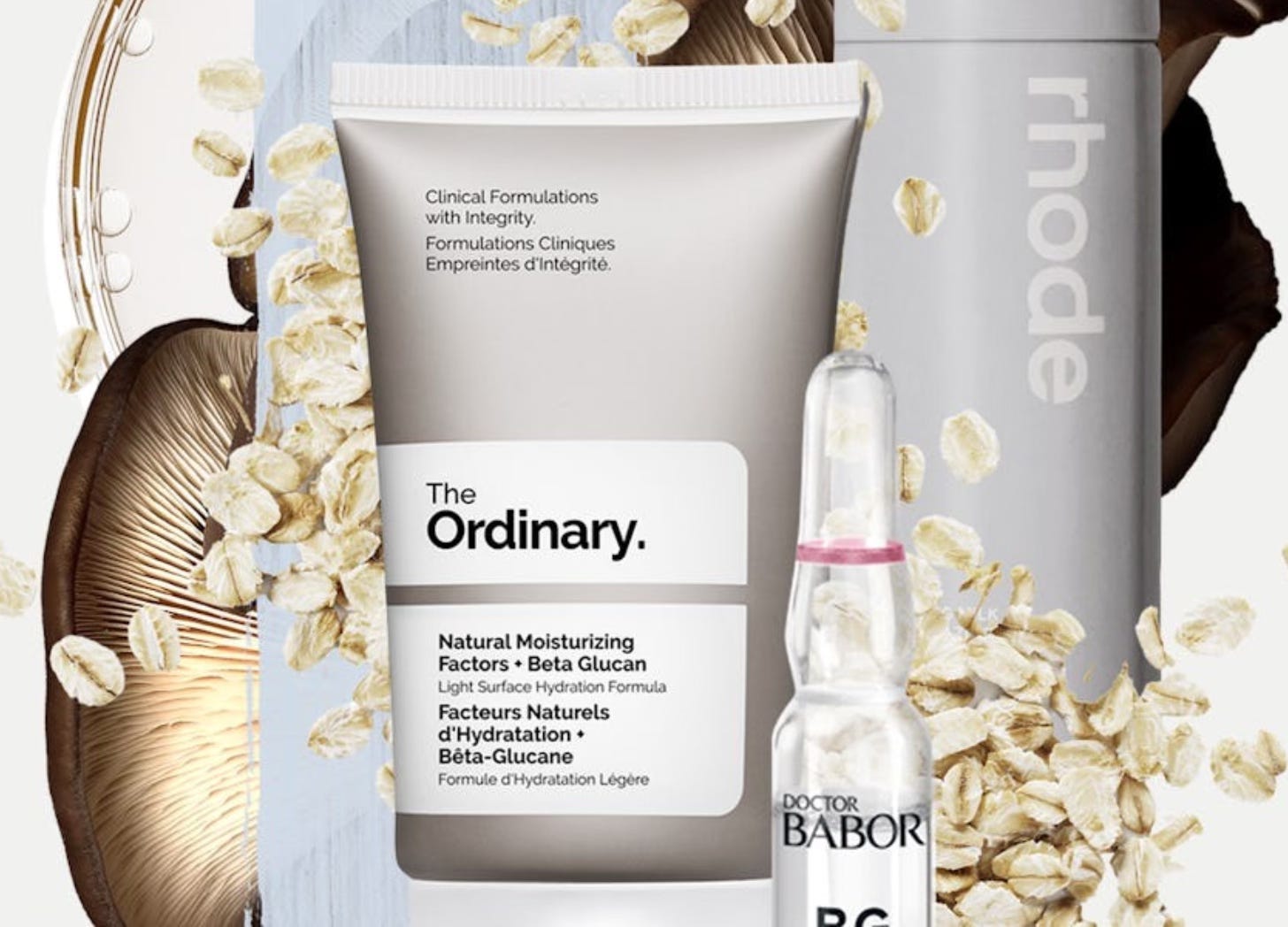
The Basics, Without the Marketing Bullsh*t
Beta-glucan is a naturally occurring polysaccharide, a long-chain sugar molecule, found in the cell walls of oats, yeast, barley, and certain mushrooms. It has been a workhorse in wound care and medical research for decades, which tells you something important right away: this is not an ingredient that showed up because a brand needed a new hero story. Have you wondered why so many products targeting irritated, sensitive skin contain oat-based ingredients? That instantly soothing, calming quality you notice on your skin is largely beta-glucan doing its job. The ingredient is not new. What is new is that the skincare industry is finally paying it the serious, sustained attention it deserves.
In a well-formulated product, beta-glucan is genuinely multitasking. It functions as a humectant, drawing moisture into the skin and holding it there. It is anti-inflammatory, meaning it actively calms redness and irritation at a cellular level. It acts as an antioxidant, neutralizing free radical damage. And it supports the skin’s own repair mechanisms in ways that are measurable and clinically documented. That is a lot of performance from a single ingredient, and the buzz is based on clinical data, not marketing.
The Penetration Problem (That Turned Out Not to Be a Problem)
For years, formulators and clinicians assumed beta-glucan’s large molecular structure would prevent meaningful skin penetration.
The assumption was logical. And it was also wrong.
A 2005 study published in the International Journal of Cosmetic Science by Pillai, Redmond, and Röding was the first to demonstrate, using ex vivo human skin models, that oat beta-glucan does, in fact, penetrate the epidermis and dermis despite its molecular weight.
A clinical arm of the same study followed 30 subjects over eight weeks, and proved efficacy by showing significant reductions in wrinkle depth and height, overall skin texture (roughness), and sensitivity.
That’s not marketing copy. That’s peer-reviewed data.
The mechanism of penetration is equally interesting: beta-glucan moves through intercellular channels rather than passing directly through cells, meaning it permeates the skin by traveling between keratinocytes rather than disrupting them. This is part of why the ingredient is so well tolerated, even by sensitive and compromised skin.
What “Barrier Repair” Actually Means Here
Barrier health has become one of those phrases so overused by cosmetic marketers that it barely means anything anymore. But with beta-glucan, the barrier story is real and specific, and it’s worth understanding why.
Research published in 2025 in Food Science and Nutrition confirms that oat beta-glucan activates the Dectin-1 signaling pathway, a cellular communication channel that tells the skin to rebuild. That activation upregulates key structural proteins, filaggrin and loricrin, which are essential to stratum corneum integrity. The stratum corneum is the outermost layer of the skin, your first line of defense against the world. When filaggrin and loricrin function well, that layer remains strong, supple, and properly sealed. Beta-glucan also promotes claudin-1, a tight junction protein that governs how effectively the barrier prevents water loss and blocks environmental aggressors from getting in.
A separate clinical study reinforces this in more practical terms. Participants with sensitive skin applied a formula containing 0.5-2% beta-glucan twice daily for 6 weeks. The result: measurable improvements in stratum corneum water retention and barrier function, with zero erythema, meaning no redness, no irritation, no inflammatory response whatsoever. For a cosmetic ingredient making barrier repair claims, that is a stringent evidentiary bar. Beta-glucan cleared it without breaking a sweat.
Why 2026 Is the Right Moment
The industry has spent the better part of the past decade chasing novelty. We have had mushroom adaptogens, bakuchiol, polyglutamic acid, and any number of ingredients elevated by people who have never read a formulation brief in their lives. Beta-glucan is different because its science substantially precedes its current trend status. The clinical literature on its wound-healing, barrier-supporting, and anti-inflammatory properties has been building since the early 2000s, grounded in peer-reviewed research rather than brand-funded claims.
Consumer behavior is also shifting in ways that favor it. Data from the Boots 2026 Beauty and Wellness Trends Report shows that 80 percent of adults now approach skin care as a long-term investment rather than a quick fix, with nearly half adjusting their routines specifically to manage sensitivity and environmental stress. Beta-glucan is precisely the ingredient that serves that consumer: calm, multifunctional, exceptionally well-tolerated, and backed by evidence that predates its moment in the spotlight by two decades.
#MyTwoCents
Beta-glucan is not a trend. It is an ingredient with a decades-long track record and a research portfolio that most overhyped actives could only dream about. When it shows up in a product you’re considering, it is there because it works, not because some brand needed a compelling hero story for a relaunch.
What to look for: beta-glucan in serums and barrier creams, ideally in the first half of the ingredient list, where its concentration is actually doing something meaningful. Pair it with ceramides and a solid moisturizer, and you have a barrier-supportive routine grounded in real science, not wishful thinking.
The ingredient trend cycle will keep spinning. Beta-glucan was here long before the current noise, and it will still be delivering results when the next viral molecule has come and gone.
Kevin James Bennett is a multiple Emmy Award-winning makeup artist, respected industry expert, cosmetic developer, and educator. He is the publisher of In My Kit®
Super informative as expected! Thank you.